Lobbying as a tool for Ukraine’s recovery: why now is the right time (Part 2)
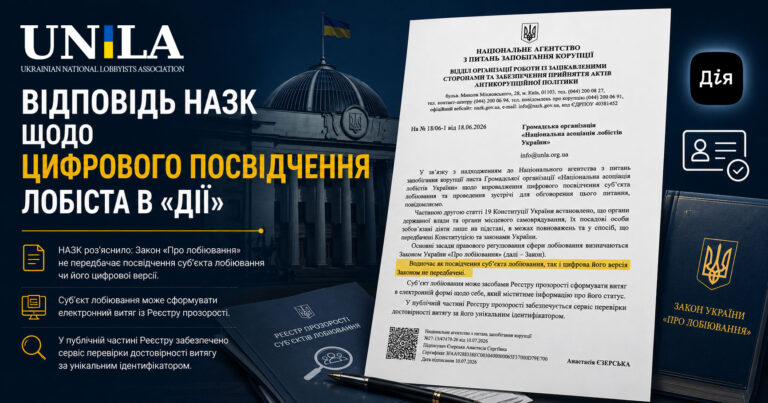
The introduction of Western standards for regulating lobbying has become one of the most important steps in reforming the Ukrainian legal system and fighting corruption. In March 2024, the Law ‘On Lobbying’ came into force in Ukraine. This document outlines clear guidelines for individuals seeking to influence government decisions. Lobbyists are now required to register in a special register maintained by the NACP and report on their contacts with officials. This allows citizens to see who is promoting certain initiatives and for what purpose.
Law firms in Ukraine have not been left out either – over the past two years, they have gradually begun to develop new practices, studying the Western experience of lobbying, and preparing for the emergence of demand for this service from both business and the public sector. This means that the market is preparing to work legally with a new instrument of influence – without shadows, without backroom deals, without backroom agreements.
We have already discussed the need for such legalization in the first part of this article. We discussed why lobbying in Ukraine has traditionally had a negative reputation and how this institution actually functions in democratic countries – as a tool for transparent influence, balancing interests and mediation between the government, business and society.
Today, we have the opportunity to utilize these new rules to achieve the significant goal of effective and fair recovery of Ukraine.
From prejudice to systemic political participation
For many years in Ukraine, lobbying has been associated with something dubious and sometimes outright corrupt. Due to the similarity to the provisions of Article 369-2 of the Criminal Code (abuse of influence), any attempt to influence officials or MPs was perceived as a dangerous zone where business and the public allegedly had no right to transparent representation of their interests.
The new law “On Lobbying” is gradually changing this paradigm. However, it is worth noting that its provisions are currently focused only on protecting commercial interests, leaving out of the legal field some activities of public associations, think tanks, expert communities, or initiatives related to social reforms. This creates a certain “gray area” for civil society organizations that also seek to influence policy but are not business entities.
In contrast, the European Union has a much broader approach to lobbying. There, it is perceived as a normal and necessary tool for participation in the political process. According to the inter-institutional agreement between the European Parliament, the European Council, and the European Commission (dated May 20, 2021), lobbying is any activity aimed at influencing the development or implementation of policies, legislation, or decisions of European institutions.
Forms of lobbying in the EU include:
- participation in consultations, hearings, and forums;
- organizing public campaigns or meetings with officials;
- preparation of research, position papers, open letters, or reports;
- participation in communication platforms and initiatives.
The key thing is that lobbying in Europe encompasses not only business interests, but also civic, environmental, human rights, educational, and other socially important causes. And even more importantly, it is perceived as an integral part of the democratic process. Article 11 of the Treaty on European Union explicitly requires an open, regular dialogue between institutions and civil society. That is why the European Commission, the European Parliament, and national delegations actively communicate with experts, business representatives, and NGOs to make decisions that meet real needs.
Agreement with the US: a new vector of Ukrainian lobbying
On May 1, 2025, Ukraine and the United States signed the so-called “minerals deal,” and on May 30, a strategic partnership agreement was signed. The agreements establish a legal framework for the launch of the Ukraine-U.S. Investment Fund, a mechanism that provides U.S. businesses with access to key sectors of the Ukrainian economy, including infrastructure, energy, agriculture, and industry. For Ukraine, this represents a new level of security and economic cooperation, while for the United States, it is a tool for geo-economic presence. However, for lobbyists, it is a space for practical work on realizing investment potential.
For lobbyists, both Ukrainian and international, this is a unique opportunity to influence the architecture of the new procedures, among other things:
- formulating project selection criteria;
- advocating for the interests of Ukrainian businesses seeking to become partners or contractors with U.S. investors;
- developing mechanisms for transparent approval of budget funding, tax benefits, and institutional support for projects.
Formally, the document does not limit participation in the fund to large corporations, but the risk of small and medium-sized enterprises being forced out is quite real. That is why the task of civil society, business associations, and professional lobbyists is to strike a balance between openness to American investors and accessibility of instruments for Ukrainian participants.
Finally, the key is that the details – including financing mechanisms, contribution procedures, tax regime – have not yet been finalized. This creates a “window of opportunity” for those who want to shape these rules in accordance with the principles of good governance, fair competition, and economic growth. It is at this stage that the active participation of lobbyists can turn a potentially non-transparent structure into an effective tool for Ukraine’s modernization.
To be continued…