
What Is Happening on the Lobbying Market in Europe?
By Oleksiy Shevchuk, Chairman of the Board of the National Association of Lobbyists of Ukraine, Partner at Barristers Law Firm, Chairman of the Lobbying Committee of the National Association of Advocates of Ukraine
New EU Transparency Rules Set to Redefine Lobbying Practices
From 1 September 2025, the European Parliament introduced new transparency rules that reshape how lobbying is conducted across the EU. Under the conditionality measure, only registered and active interest representatives may meet Parliament officials in managerial positions — from Directors-General to Cabinet team leaders. Unregistered lobbyists are now barred from official meetings, reinforcing the EU’s message that transparency is a prerequisite for influence.
The rules also require mandatory publication of all meetings with lobbyists and non-EU public representatives within 30 days on Parliament’s website, further aligning with Europe’s broader push for open governance.
Though procedural in appearance, the reform sets a new standard for compliance and may significantly reshape lobbying strategies across the continent. Whether it sparks similar reforms in member states remains to be seen, but the direction is unmistakable — Europe is moving toward deeper transparency and accountability.
Tech Giants Expand Their Influence: Lobbying Expenditures Surge by 33%
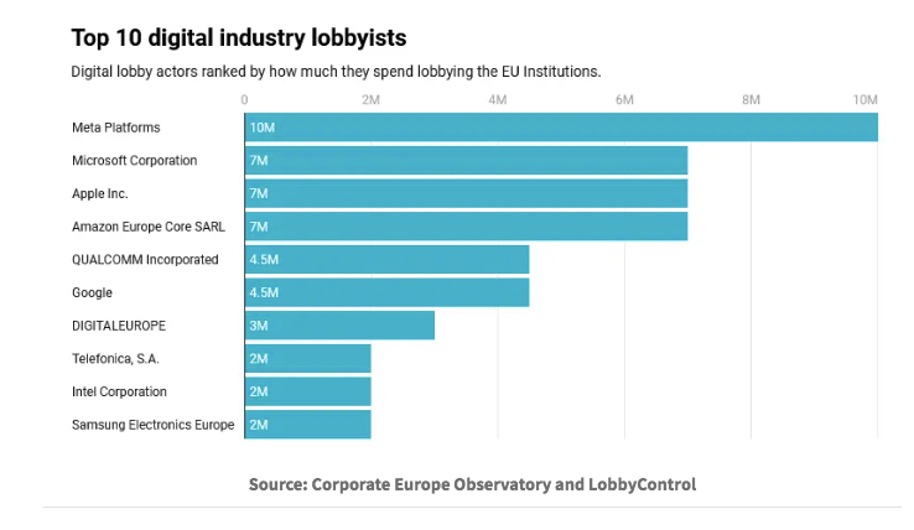
As the EU tightens transparency rules, Big Tech is expanding its influence at record speed. A report by Corporate Europe Observatory and LobbyControl shows that combined lobbying spend by Meta, Microsoft, Apple, Amazon, and Google rose by over 33% in two years — from €113 million in 2023 to €151 million in 2025.
Just ten companies, seven of them U.S.-based, account for one-third (€49 million) of total lobbying expenditure, underscoring the strategic importance of the European market. With the Digital Markets Act, Digital Services Act, and upcoming AI legislation, Brussels has become a central battleground for global tech interests.
There are now more full-time tech lobbyists in Brussels than Members of the European Parliament, reflecting how essential corporate advocacy has become for navigating Europe’s increasingly assertive regulatory agenda.
Big Tech’s Growing Pressure on EU Policymaking
The rise in lobbying is driven by a few dominant players. Amazon added €4.3 million, while Microsoft and Meta each spent €2 million more, and the association DIGITALEUROPE contributed an extra €1.25 million. This coordinated effort targets key EU digital regulations, including the AI Act, DMA, and DSA.
Big Tech now averages more than one lobby meeting per day with European Commission officials, totaling 146 meetings in the first half of 2025. The European People’s Party has held a disproportionate number of these meetings, highlighting political alignment with tech interests.
The lobbying ecosystem is rapidly expanding: the number of tech-aligned actors in Brussels grew from 565 in 2023 to 733 in 2025, and there are now more full-time lobbyists than MEPs. Top ten digital firms spend three times more than leading pharmaceutical, financial, and automotive companies, and twice as much as the energy sector.
In addition to direct lobbying, Big Tech spends over €9 million annually on consultancies, PR firms, and think tanks to shape public discourse. Despite this pressure, EU lawmakers continue to enforce regulations and maintain investigations and fines against companies such as Google, Meta, and TikTok, showing resilience against lobbying influence.
Looking Ahead
Europe’s lobbying landscape is evolving rapidly, shaped by stricter transparency rules and rising influence from Big Tech. The EU faces a delicate balance between accountability and corporate pressure, which will determine both policymaking credibility and democratic integrity. The key message for the lobbying market is clear: the era of unregulated influence is over, and success now depends on operating openly, ethically, and strategically.