Lobbying in Ukraine: a legal instrument of influence with clear rules and sanctions
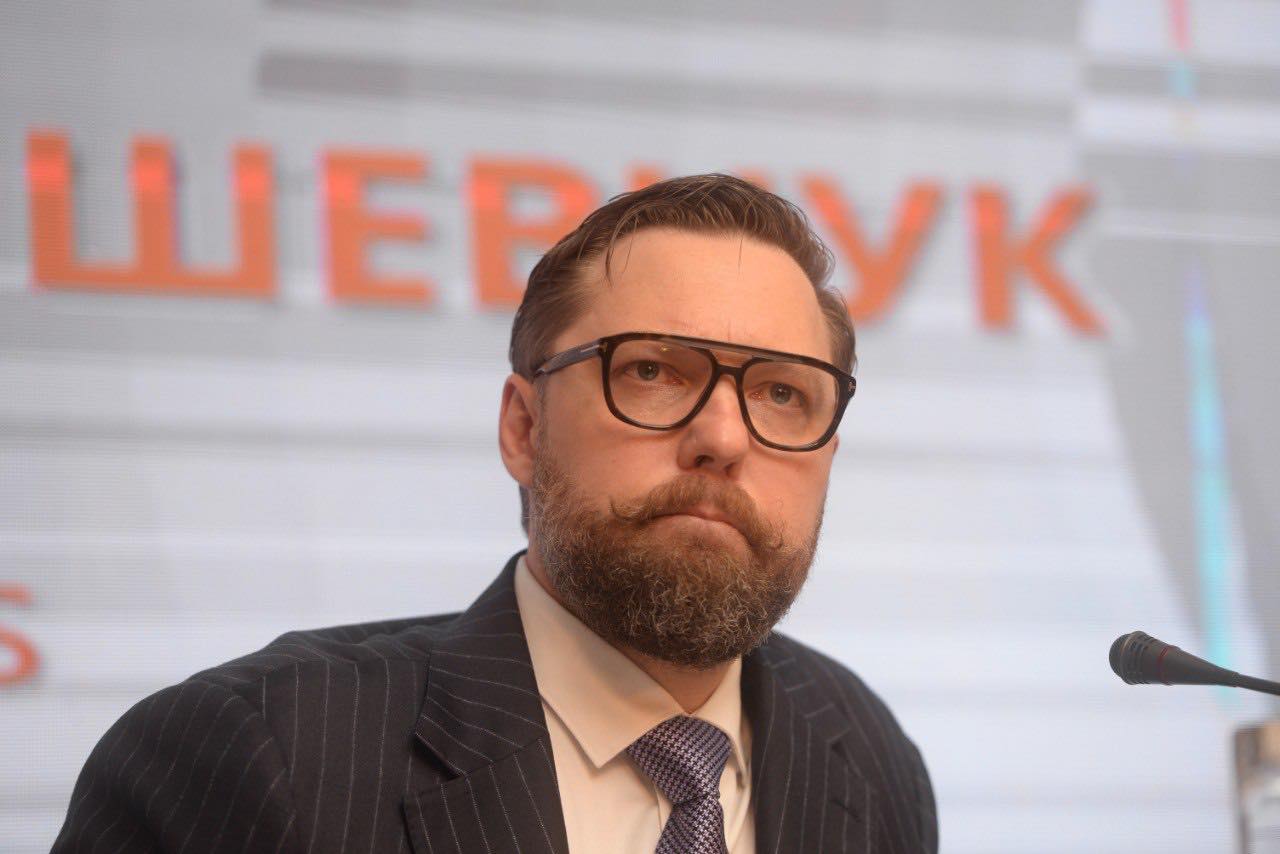
OLEKSII SHEVCHUK, partner, spokesperson at Barristers, Chairman of the Board of the Ukrainian National Lobbyists Association
In Ukraine, lobbying is gradually becoming a normal part of the democratic process. It allows businesses and civil society organizations to openly influence the way decisions are made in the government.
The Law on Lobbying sets clear rules of the game: who can lobby, what methods are allowed, and what liability is provided for violations. The goal is simple: to make this process transparent, fair and working for the country’s development, not for shadowy interests. As of the fall of 2025, most lobbying activity is concentrated in the areas of economic development, as well as legal, financial, tax and customs policies.
When we talk about lobbying, we mean influencing various legal acts – the very documents that determine the rules and decisions in the country. Lobbying activities can relate to all stages of working with such acts: from their planning and development to amending or even repealing them. The main idea of this process is to convey the position of business or the public to the authorities so that these interests are taken into account in public policy.
At the same time, the law clearly defines the topics that cannot be lobbied at all. These are primarily issues related to national security and emergencies. These include decisions on mobilization, the introduction of martial law or a state of emergency, the declaration of war or the conclusion of peace, the use of the Armed Forces, changes to the territory of Ukraine, the definition of environmental disaster zones, or decisions on amnesty. Such areas are considered highly sensitive, and the state protects them from any private influence to avoid risks to the country’s sovereignty and security.
Lobbying methods: from communication to public campaigns
Lobbying in Ukraine, as in the West, is based on basic principles: it must be legal, transparent, professional and ethical. The law explains in some detail how to influence decision-making. First of all, it is live communication with officials or other responsible persons, when a lobbyist conveys the position of his organization or client. In addition, various informational materials are widely used, such as analytics, research, proposals, or simply explanatory documents that can be distributed directly, through the media, or on the Internet.
Participation in events and discussions related to a particular policy is also important, and sometimes they organize their own events or public campaigns to help draw attention to the issue. Lobbyists can invite government officials to discussions, conferences, or other venues where they can present their arguments more broadly. In general, the law allows the use of various methods of influence, as long as they do not contradict the Constitution and Ukrainian legislation. This allows for open and effective representation of interests without going beyond the legal framework.
Who cannot engage in lobbying?
In order to avoid abuse and conflicts of interest, the law strictly limits the range of people and organizations that can be granted lobbyist status. First of all, this applies to current public servants, as well as those who left office less than a year ago, apparently to prevent the use of official connections for private purposes. People with outstanding convictions or corruption-related violations, as well as those whose legal capacity is legally limited or who have not reached the age of majority, are also not allowed.
A separate restriction applies to citizens and residents of the Russian Federation, as well as companies associated with or registered in this country. Similarly, entities associated with terrorist activities, sanctioned individuals and organizations, as well as those who do not comply with international anti-money laundering standards, are not allowed to engage in lobbying. The law also blocks access for legal entities that have beneficiaries belonging to any of these prohibited categories.
State bodies, local governments, public law institutions, mass media, political parties, religious organizations and election candidates are also banned. Restrictions also apply to companies that have been subject to criminal sanctions over the past five years. All of this creates safeguards that prevent lobbying from becoming a space for manipulation or covert influence, while maintaining it as a civilized and controlled tool.
Liability for violations: fines and prohibitions
Violation of the lobbying rules in Ukraine is not limited to moral judgment – there is a very specific administrative liability for this. All fines are set through the system of non-taxable minimum incomes, so even seemingly insignificant sanctions can turn into substantial sums.
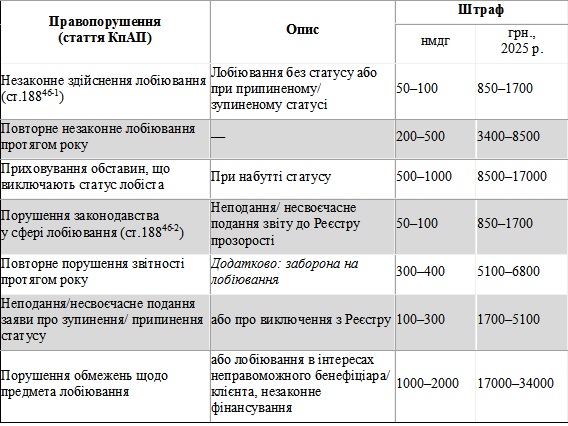
The most common violations relate to concealing information, working without proper registration, or attempting to influence officials in a way that is expressly prohibited by law. In such cases, fines are imposed, and sometimes even temporary bans on lobbying activities are imposed. In effect, the state is signaling that lobbying is allowed, but only in an open, transparent manner and within the framework of certain rules. This should deter those who would try to turn lobbying into a means of pressure or covert influence, while at the same time protecting the credibility of the mechanism itself.
These sanctions emphasize the importance of transparency and ethics in lobbying activities.
Lobbying in Ukraine, which is regulated by a special law, contributes to the balance of interests in society, but requires strict adherence to the rules. Experts note that effective implementation of these rules can increase trust in the government and stimulate economic development.