
Family 2026: Why money will not save demographics, but “time and peace” will
Violetta Rybachkovska, lobbyist
Postwar Ukraine is entering a period when not only investment and infrastructure rebuilding are becoming the key resources for recovery. People are becoming the most scarce resource. Demography is transformed from abstract statistics into a factor of national security.
We are used to thinking of family support as social assistance: maternity benefits, compensation, subsidies. But global experience demonstrates a simple fact: money alone does not produce children. Children are born where there is a sense of stability, time and psychological security.
The issue is not the amount of payments. The issue is the structure of the social contract.
Family as an economic cluster
In the post-war development model, the family should not be viewed as a socially vulnerable category, but as the basic cluster of society. It is the family that forms human capital, adapts veterans, stabilizes communities, and reproduces the economy.
If the state continues to work in the logic of short-term transfers, it will finance the consequences of the crisis. If it changes the rules of the game, it will invest in sustainability.
What does this mean in practice?
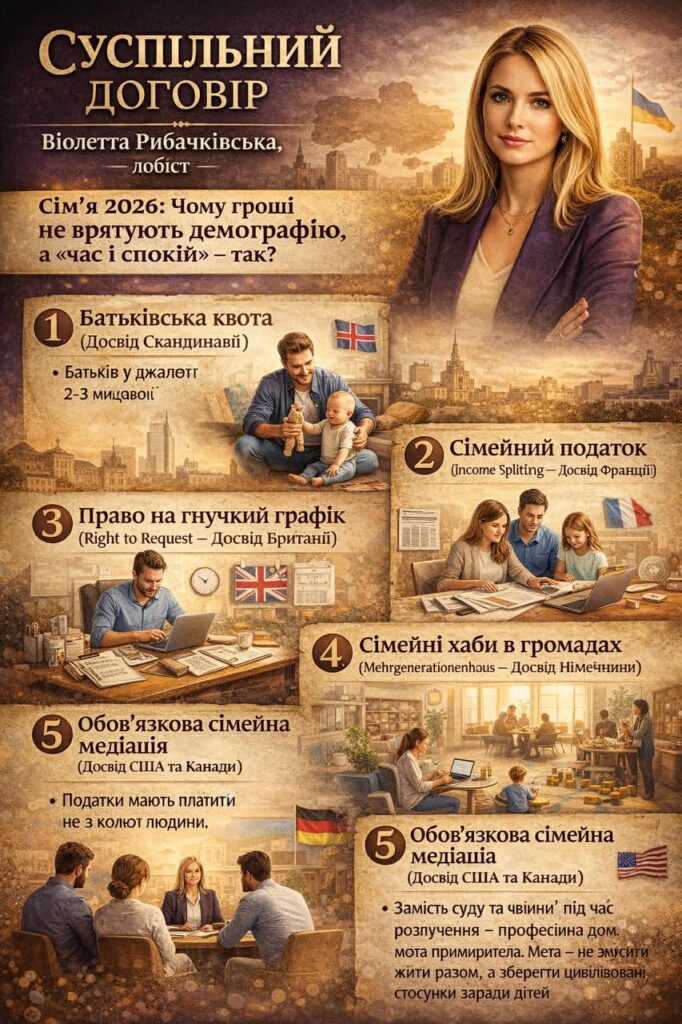
1. Parental quota: a tool for reintegration
In Scandinavia, part of the maternity leave belongs exclusively to the father. If he doesn’t use it, it burns off. This encourages men to participate in childcare from the first months of life.
For Ukraine, this tool has a special meaning. After the war, thousands of men will face a difficult path to return to civilian life. The father quota can become a soft mechanism for reintegration, forming a new type of male role – not only a protector, but also an active father.
This is not about social policy. It is about the long-term psychological stability of society.
2. Family tax: financial predictability instead of handouts
The French model of income splitting provides for taxation of family income based on the number of children. The more children, the lower the tax burden.
For business, this means predictability. For a family, it means the ability to plan life for years to come.
One-time aid creates situational support. Family taxation creates a foundation. It recognizes the family as an economic unit, not just a collection of individual taxpayers.
3. The right to flexibility: work for life, not vice versa
The British Right to Request model guarantees parents the right to request a flexible schedule or remote work until their child reaches a certain age.
After the war, the Ukrainian labor market will be transformed – partly digitalized, partly mobile. If the legislation does not take into account the interests of families, the country will experience a massive outflow of young professionals to places where work does not conflict with parenthood.
Flexibility is not a privilege. It is a competitive advantage of the economy.
4. Family hubs: infrastructure of trust
In Germany, there are multigenerational centers that combine coworking, children’s spaces, social counseling, and a community of mutual support under one roof.
Post-war communities in Ukraine will need such points of attraction. This reduces isolation, forms horizontal connections, and creates a new level of social capital.
Strong communities are born not from the budget, but from trust.
5. Mandatory family mediation: reducing conflict
The experience of the United States and Canada shows that mediation during divorce significantly reduces conflicts, protects children’s mental health, and relieves the judicial system.
For Ukraine, which is experiencing a tremendous level of trauma, this is not just a legal mechanism. It is the prevention of social disintegration.
Why money doesn’t work without rest
Demographics is an indicator of trust in the future. People have children when they believe that tomorrow will be predictable.
No financial payment can compensate for lack of time, fear of losing a job, or chronic instability.
A new social contract for Ukraine should answer three questions:
1. 1. Does the family have time?
2. Does it have predictability?
3. Does it feel supported by institutions, not just budget transfers?
Investment in parental resilience
The state can choose:
either fund crisis response institutions or invest in parental resilience.
Postwar Ukraine has a chance to establish a new model – not a social model, but a structural one. The family as a cluster of economy, psychological stability and national security.
Demographics will not be saved by money.
She will be saved by an environment where having a child does not mean losing your career, income, or inner peace.
And this is where the new social contract begins.