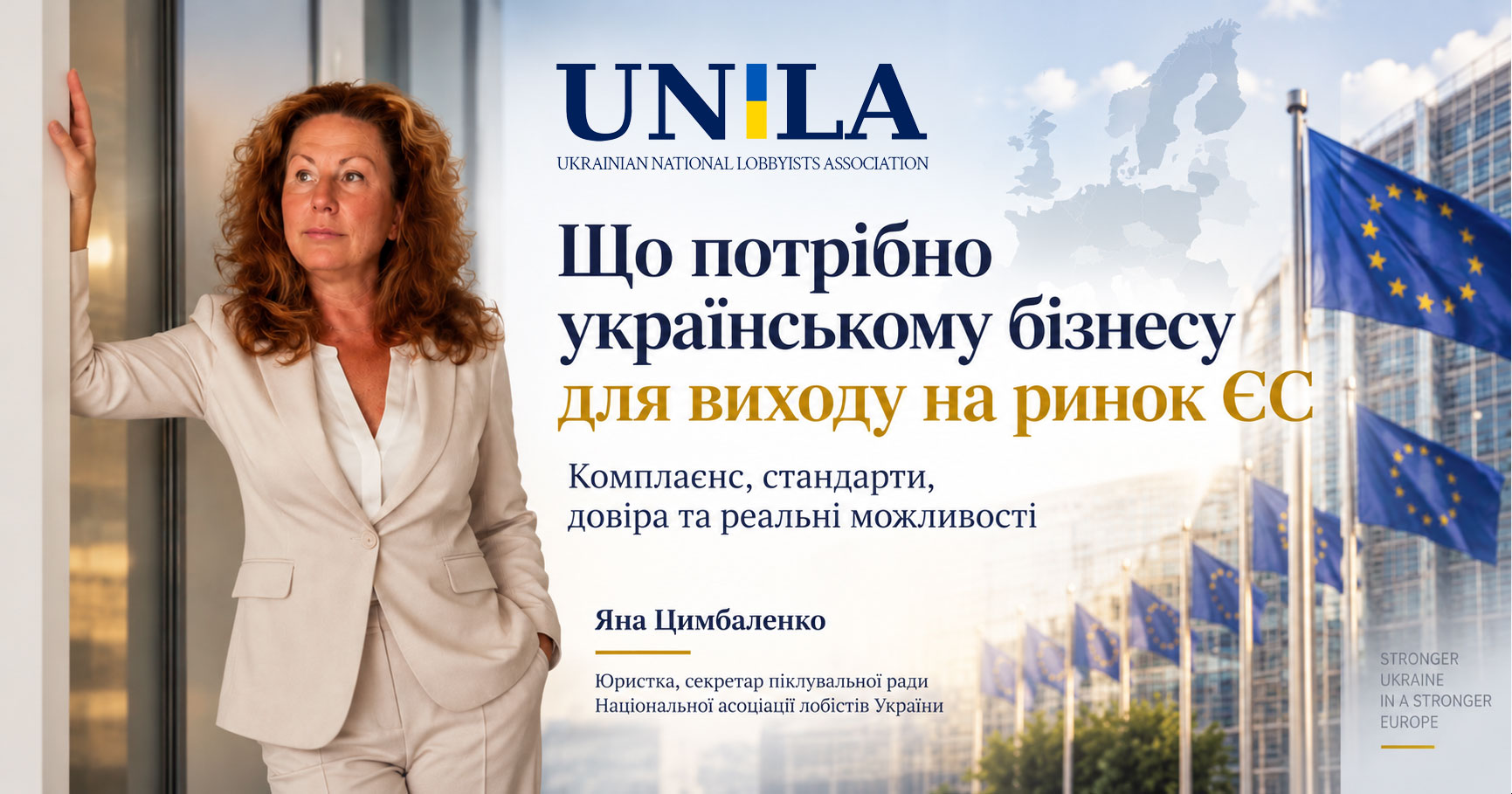
What Ukrainian Businesses Need to Enter the EU Market
Yana Tsymbalenko, lawyer, secretary of the Board of Trustees of the Ukrainian National Lobbyists Association, expert in the field of public administration, Honored Worker of Education of Ukraine, academician of the Academy of Political and Legal Sciences
Entering the EU market requires businesses not only to offer high-quality products but also to be prepared to comply with European standards.
Let’s imagine a Ukrainian company that plans to enter the European market. It invests in product certification, marketing, document translation, and finding partners. It directs its financial, human, and organizational resources toward reaching new horizons.
And so, a partner has been found.
The business model for future cooperation is taking shape, negotiations are beginning, and the company already sees itself as a supplier of products to the EU or even to global markets. However, the potential counterparty sends a compliance questionnaire with questions about beneficial owners, conflicts of interest, sanctions risks, personal data protection, whistleblowing channels, and supply chain accountability.
Unexpectedly.
It is at this very moment that organizational culture takes on a new meaning and a very specific monetary dimension.
The answers to these questions—which may seem simple at first glance—can determine whether a contract will be signed, whether the company will be included in the supply chain, and whether the European partner is even willing to begin working with the company.
I am convinced that entering the EU market requires more than just high-quality products, competitive prices, and a successful marketing strategy. It requires a management system based on transparency, accountability, integrity, and sound risk management.
European partners evaluate suppliers based on more than just product specifications. A company’s readiness to collaborate depends largely on whether it complies with laws, adheres to internal policies, vets its business partners, and ensures compliance with industry standards.
Which EU requirements are becoming critical for businesses?
For example, EU Directive 2024/1760 on due diligence for corporate sustainability requires companies to identify, assess, and minimize the negative impacts of their operations and supply chains on human rights and the environment.
For Ukrainian businesses, this means being prepared to respond to inquiries regarding product origin, working conditions, environmental impacts, and ownership structure.
EU Directive 2022/2464 on corporate sustainability reporting establishes new standards for transparency. Companies must not only declare their intentions but also substantiate them with verifiable data and explain the link between their goals and results.
EU Directive 2019/1937 on the protection of whistleblowers establishes requirements for internal channels for reporting violations and safeguards for employees. This is not a mere formality, but a tool for the early detection of risks.
The EU General Data Protection Regulation (GDPR) sets forth the rules for handling personal data. For businesses, this means having full control over what data is collected, how it is used, where it is stored, and to whom it is disclosed.
This list is not exhaustive. It also includes issues related to fair competition, anti-corruption practices, sanctions compliance, and transparent contractual relationships.
Compliance as an Economic Consideration, Not a Formality
To ensure consistent operations in the EU market, businesses use compliance tools.
This is often seen as an additional burden. However, compliance has clear economic significance.
Economic impact = avoided losses + additional revenue + operational savings + financial benefits − implementation costs.
Investments in compliance include process audits, policy development, counterparty due diligence, staff training, and ensuring information security.
At the same time, they help avoid fines, legal costs, contract breaches, and reputational damage. In addition, they open the door to new partnerships, contracts, and funding.
Why a formal approach doesn’t work
I do not consider the number of approved policies to be an indicator of effectiveness. What matters is how the system influences management decisions, employee behavior, and financial results.
Compliance that is implemented merely as a formality, without management support, risks remaining nothing more than a declaration.
Top management determines whether compliance will be part of the business strategy. Middle management ensures its implementation through processes and oversight.
The Role of Culture and Education
Employees don’t need declarations; they need clear guidelines for how to act in real-life situations. That is why training must be practical, regular, and tailored to different levels of responsibility.
Formal lectures or reviewing documents do not change behavior. Only systematic work with real-world cases yields results.
Preparation for the EU market must be ongoing and integrated into business processes.
A Key Issue for Businesses
Ultimately, management must answer a simple question:
How much is a company willing to invest in its preparedness today—and how much could it lose tomorrow because of a lack of preparedness?