
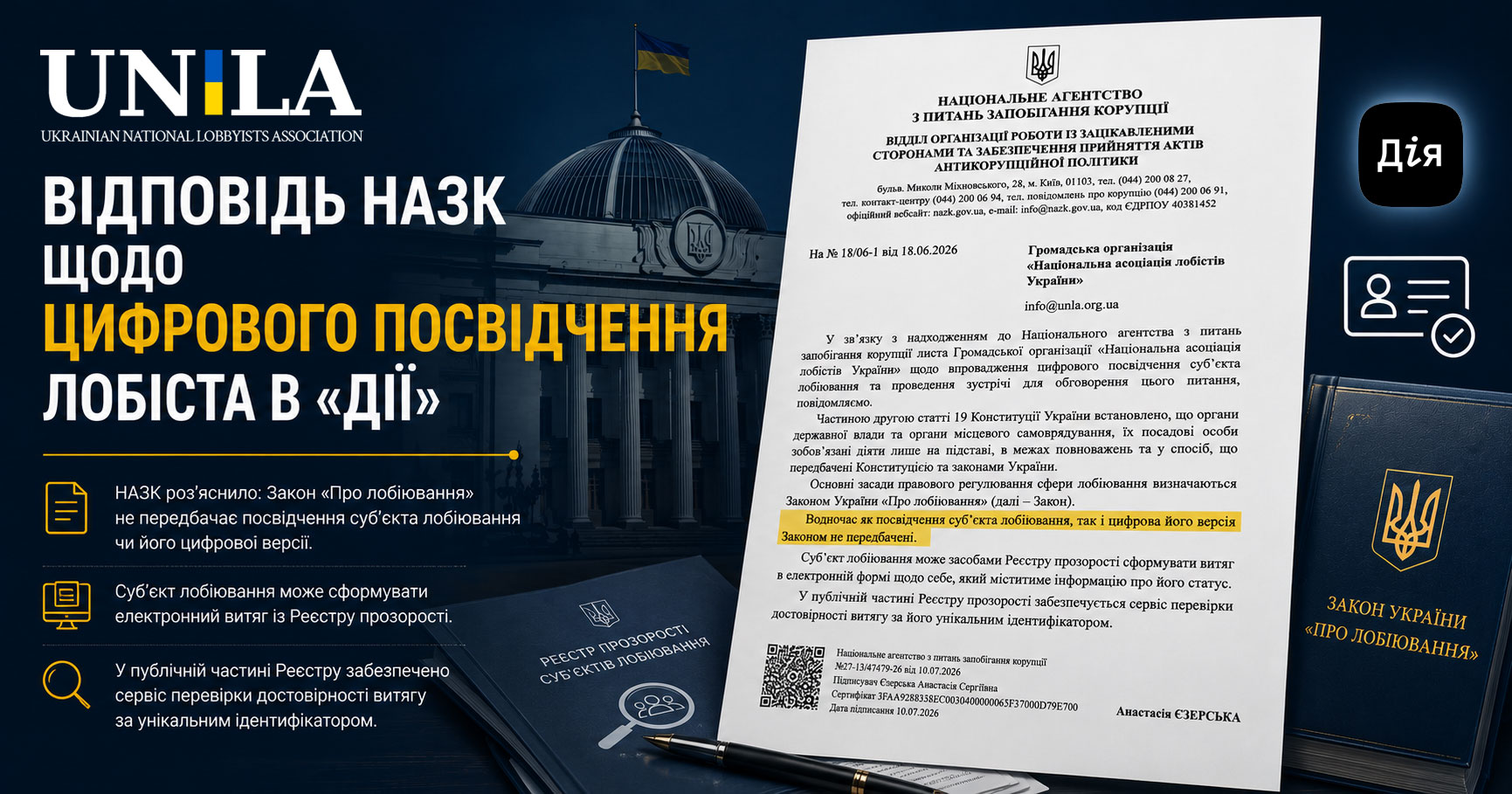
The NACP’s formalistic approach is effectively hindering the implementation of the digital lobbyist ID in “Diia”
The introduction of legislative regulation of lobbying in Ukraine was intended to make the process of representing interests transparent, professional, and understandable to the state and society. At the same time, the practical implementation of the new rules requires not only regulatory requirements but also modern digital tools that will make it possible to quickly and reliably verify the status of a lobbying entity.
The Ukrainian National Lobbyists Association has proposed the introduction of a digital lobbyist ID in the “Diia” app. Such a tool could automatically display up-to-date information from the Transparency Register and enable rapid verification of a person’s status when interacting with government agencies, members of parliament, local government bodies, and other entities subject to lobbying.
The initiative does not involve the creation of a new legal status, a separate registry, or an additional permit-type document. It simply involves a convenient digital format for presenting existing government data.
The Ministry of Digital Transformation of Ukraine has confirmed that it is technically feasible to implement the service in question, provided that its concept is approved by the National Agency for the Prevention of Corruption. However, the NACP pointed out that current legislation does not explicitly provide for a lobbying entity certificate or its digital version, and proposed using an electronic extract from the Transparency Register instead.
This approach effectively hinders the implementation of a digital initiative that could significantly simplify the work of registered lobbyists and facilitate the practical enforcement of the Law of Ukraine “On Lobbying.”
The fact that the law does not explicitly mention digital certificates does not in itself mean that it is impossible to create a technical tool for displaying information from the state registry. A digital document in “Diia” would not replace the Transparency Register, but would simply provide convenient access to its up-to-date data.
Currently, lobbyists are required to generate an electronic extract separately, store it, and present it during professional interactions. While this procedure is technically feasible, it is not sufficiently convenient for day-to-day operations, especially given the frequency of contact between lobbyists and public officials.
The NACP’s position reflects an overly literal interpretation of current legislation and creates an institutional barrier to the implementation of the service, the technical feasibility of which has already been confirmed by the relevant ministry.
Instead of finding a legal mechanism to implement the initiative, the professional community was effectively given an explanation of why the current—albeit cumbersome—procedure must remain unchanged. This approach is difficult to reconcile with the national policy on the digitization of public services and the principle that government services should be tailored to the needs of their users.
A digital lobbyist ID would simplify the verification of professional status, reduce the administrative burden, increase trust in the Transparency Registry, and more clearly distinguish registered lobbying activities from informal and non-transparent influence.
It is particularly important that such a tool would not only benefit the lobbyists themselves. Government officials could verify, in real time, a person’s authority, the validity of their status, and the legality of their professional interactions.
The Ukrainian National Lobbyists Association has consistently emphasized that a digital ID is not a privilege reserved for members of the profession. It is a logical component of a transparent lobbying regulatory system and a practical tool for implementing the principles of openness, accountability, and integrity.
UNLA calls on the NACP to move away from a purely formal approach and join efforts to develop legal and technical solutions in collaboration with the Ministry of Digital Transformation and representatives of the professional community.
A government that requires transparency from lobbyists must, for its part, establish clear and modern mechanisms for verifying their status.