The Lobbying Market in Ukraine: Results for the First Half of 2026 and In-Depth Analysis by Dmytro Buzanov
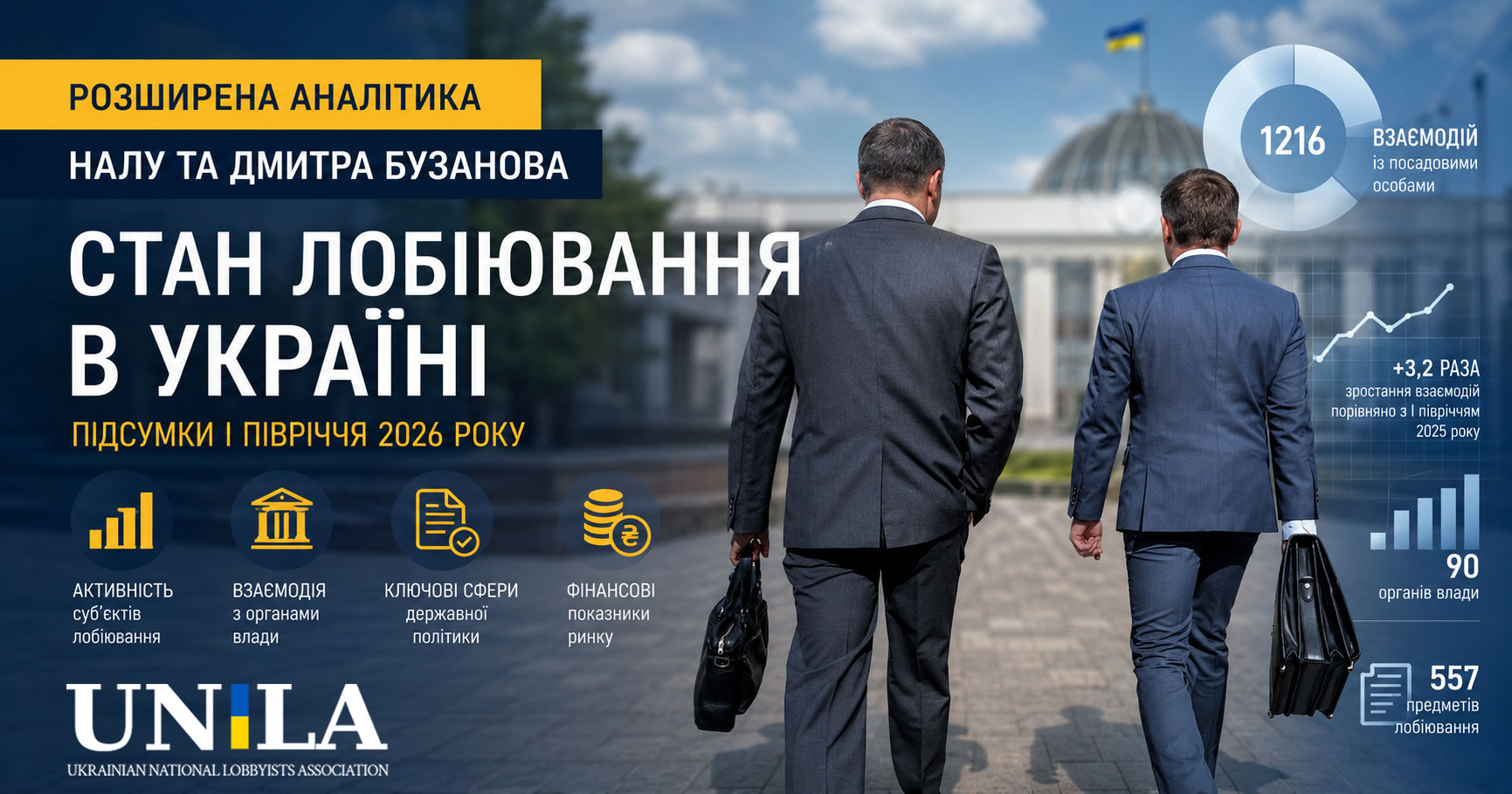
This in-depth analysis by the Ukrainian National Lobbyists Association and attorney and lobbyist Dmytro Buzanov focuses on the results of the second reporting campaign by lobbying entities and an analysis of the state of the lobbying market in Ukraine for the first half of 2026.
This analysis is based on open data from the NACP Transparency Registry and highlights key trends in the development of the new lobbying framework: the activity of lobbying entities, their interaction with government authorities, priority areas of public policy, financial indicators of the market, and the results of the practical implementation of the Law of Ukraine “On Lobbying.”
At the same time, the Ukrainian National Lobbyists Association continues its systematic work on developing the professional environment. Among the Association’s key areas of activity are preparing proposals on the taxation of lobbying activities, developing the professional standard “Government Relations Professional,” providing guidance on the application of lobbying legislation, and the professional protection of lobbyists in Ukraine.
Below is the full text of an analytical study by Dmytro Buzanov, originally published on glavcom.ua, with editorial additions by the National Association of Lobbyists of Ukraine.
Who lobbied, who they approached, and what they paid for. Results for the first half of 2026
The second reporting period under the Law “On Lobbying” ended on July 31, 2026
An analysis of all reports for the first half of 2026 from the NACP Transparency Registry shows who engaged in lobbying activities, which government agencies were approached by lobbyists, which legislative initiatives were promoted, how the market structure is changing, and which trends can already be considered established.
A separate section of the study is devoted to the calculation methodology, which explains the differences between the figures published by the NACP and the results of independent analysis. Both approaches are valid, but they address different questions regarding the functioning of the market.
In Brief
The second reporting period under the Law of Ukraine “On Lobbying” ended on July 31, 2026. Reports were submitted by 156 entities out of 185 required to do so. The number of declared interactions with public officials more than tripled— from 380 to 1,216.
At the same time, the number of entities that actually engaged in lobbying activities changed only slightly— 40 compared to 35 during the first campaign. This suggests that the Ukrainian market has not yet seen a sharp increase in the number of professional players. The main reason for the rise in the statistics was that reports were filled out in much greater detail.
It is telling that more than half of all reported interactions are attributable to just three organizations.
The Campaign in Ten Figures
| Indicator | First half of 2026 | Second half of 2025 | Change |
|---|---|---|---|
| Reports submitted | 156 | 131 | +25 |
| Interactions with officials | 1,216 | 380 | ×3.2 |
| Reports with declared activity | 40 | 35 | +5 |
| Officials who were approached | 278 | 115 | ×2.4 |
| Government agencies | 90 | 46 | ×2.0 |
| Subjects of Lobbying (Unique Acts) | 557 | 246 | ×2.3 |
| Entries for “agency + official” | 1,088 | 338 | ×3.2 |
| Lobbying Agreements | 24 | 10 | ×2.4 |
| Customers and beneficiaries (unique) | 541 | 171 | ×3.2 |
| Entities Reporting for the First Time | 40 | 15 | +25 |
Source: NACP Transparency Registry; calculations by lobbyst.com.ua as of August 3, 2026.
The campaign is officially over, but reports are still coming in, so some figures may be subject to change.
Who was supposed to report and who did report
As of the end of the reporting period, there were 202 lobbying entities listed in the Transparency Registry: 98 legal entities (including three foreign entities) and 104 individuals. Of these, 174 entities continue their activities, 5 have suspended their activities, and 23 have ceased to be registered as lobbying entities.
A total of 185 entities — 92 legal entities and 93 individuals—were required to file a report.
By the statutory deadline— July 31 — 153 entities had submitted their reports, representing 82.7% of the total number of entities required to do so.
The level of discipline varied:
- legal entities — 89.1%;
- individuals — 76.3%.
As of August 3, three more reports had been submitted late. Thus, the total number of reports stood at 156, while 29 entities had not submitted any reports at all.
The law provides for administrative liability for failure to file reports: a fine ranging from 50 to 100 non-taxable minimum incomes, and for a repeat violation within a year—from 300 to 400 non-taxable minimum incomes, along with a one-year ban on engaging in lobbying activities.
Among those who submitted reports were 84 legal entities and 72 individuals.
The appearance of 40 new entities reporting for the first time deserves special attention. These include 21 individuals and 19 legal entities, which is nearly one and a half times the number from the first reporting campaign.
Foreign lobbying entities include:
- American Chamber of Commerce in Ukraine (U.S.);
- Meta International Services LLC (U.S.);
- Orlen S.A. (Poland).
The American Chamber of Commerce in Ukraine emerged as the clear leader of the second campaign across all activity metrics.
Key point: 116 out of 156 reports show no declared activities
The most important finding of the second reporting campaign is not the increase in the number of interactions or documents submitted, but rather the actual structure of the Ukrainian lobbying market.
Of the 156 reports submitted:
- 116 do not contain any lobbying issues;
- 120 do not involve any interaction with officials.
In other words, nearly three-quarters of lobbying entities officially confirmed that they did not, in fact, engage in any lobbying activities during the first half of 2026.
This does not constitute a violation of the law. The Law of Ukraine “On Lobbying” requires every registered entity to file a report, regardless of whether it engaged in any activities during the relevant reporting period.
However, it is precisely this indicator that most accurately reflects the actual state of the market: all of the country’s reported lobbying activity is, in fact, concentrated in just 40 reports.
Another trend is the high concentration of the professional market.
Just three organizations reported 642 interactions, or 52.8% of all interactions listed in the reports.
The top ten entities accounted for 1,015 interactions, representing 83.5% of the total market.
The American Chamber of Commerce in Ukraine emerged as the clear leader, reporting 437 interactions on its own—nearly 36% of all interactions recorded in the Transparency Register.
A comparison with the first reporting campaign reveals another important trend. While the number of active users increased only from 35 to 40, the number of interactions rose from 380 to 1,216.
So, the market did not triple in size.
The quality and level of detail in reporting have improved. While during the first campaign many entities were still adapting to the new rules and submitted generalized information, this year most professional participants have already been reporting each meeting, each letter, and each form of communication separately.
Another notable feature of the campaign was that most of the reports were submitted at the very end of the deadline.
Of the 156 reports:
- 84 were submitted during the last three days of the campaign— July 29, 30, and 31;
- That’s more than in all of the previous seven months combined, when 69 reports were filed.
The highest level of activity occurred on July 29 — 30 reports were submitted; another 27 reports were submitted on July 30 and on the very last day of the campaign— July 31.
At the same time, lobbying activity itself was distributed fairly evenly throughout the first half of the year:
| Moon | Number of interactions |
|---|---|
| January | 151 |
| February | 195 |
| March | 188 |
| April | 243 |
| May | 201 |
| June | 238 |
The highest figure was recorded in April, which coincided with the passage of significant amendments to tax legislation.
Top 10 Entities by Interactions with Public Officials
An interaction is defined as a scheduled meeting, participation in an event, or any other form of communication with a public official.
According to the results for the first half of 2026, 1,216 interactions were reported, of which:
- 335 — meetings;
- 275 — events;
- 606 — Other Forms of Communication.
| No. | Lobbying Entity | Interactions | Share |
|---|---|---|---|
| 1 | American Chamber of Commerce in Ukraine | 437 | 35.9% |
| 2 | Pro Advisors, LLC | 120 | 9.9% |
| 3 | European Business Association | 85 | 7.0% |
| 4 | Association of Gas Producers of Ukraine | 83 | 6.8% |
| 5 | All-Ukrainian Agrarian Council Public Association | 81 | 6.7% |
| 6 | ArcelorMittal Kryvyi Rih, PJSC | 51 | 4.2% |
| 7 | “Ukrtyutyun” | 47 | 3.9% |
| 8 | “Ader Haber Government Affairs” | 46 | 3.8% |
| 9 | National Association of the Extractive Industry of Ukraine | 35 | 2.9% |
| 10 | German-Ukrainian Chamber of Industry and Commerce | 30 | 2.5% |
Compared to the first campaign, the composition of the leading candidates has changed significantly.
While representatives of the tobacco industry used to dominate the list of the most active players, today the top spots are held by major business associations and professional government relations consultants.
The appearance of Pro Advisors LLC in second place in the ranking deserves special attention. This is no longer a business association but a professional consulting firm that provides lobbying services on a contractual basis, which indicates the gradual development of the market for professional lobbying services in Ukraine.
Top 10 Entities by Lobbying Issues
The subject of lobbying is considered to be a specific regulatory act or public policy issue regarding which lobbying activities were carried out.
A total of 557 unique lobbying activities were recorded in the first half of 2026.
| No. | Subject | Items |
|---|---|---|
| 1 | American Chamber of Commerce in Ukraine | 117 |
| 2 | European Business Association | 35 |
| 3 | Association of Gas Producers of Ukraine | 33 |
| 4 | German-Ukrainian Chamber of Industry and Commerce | 28 |
| 5 | Ukrainian Food Retail Alliance Public Association | 26 |
| 6 | All-Ukrainian Agrarian Council Public Association | 22 |
| 7 | Association of Ukrainian Entrepreneurs | 21 |
| 8 | Pro Advisors, LLC | 19 |
| 9 | European-Ukrainian Energy Agency | 16 |
| 10 | “Ukrtyutyun” | 15 |
This ranking reflects not the intensity of communication, but the breadth of each entity’s agenda.
For example, the American Chamber of Commerce worked on 117 different issues simultaneously, while Pro Advisors LLC, despite handling a large number of interactions, focused on only 19 topics, providing significantly more in-depth support for each project.
Who Did Lobbyists Approach: The Top 10 Officials
One of the key findings of the study is an analysis of which specific officials were most frequently approached by lobbyists.
In total, during the first half of 2026, interactions with 278 different officials representing 90 government agencies were reported.
The positions are listed exactly as reported by the lobbying entities in their reports, that is, as of the reporting period.
| No. | Official | Position | Interactions | Entities |
|---|---|---|---|---|
| 1 | Alexey Sobolev | Minister of Economy, Environment, and Agriculture | 68 | 7 |
| 2 | Danylo Getmantsev | Chair of the Verkhovna Rada Committee on Finance, Tax, and Customs Policy | 46 | 13 |
| 3 | Viktor Lyashko | Minister of Health | 43 | 4 |
| 4 | Taras Vysotsky | Deputy Minister of Economy, Environment, and Agriculture | 41 | 5 |
| 5 | Oleksiy Movchan | Member of the Ukrainian Parliament | 35 | 6 |
| 6 | Yulia Svyrydenko | Former Prime Minister of Ukraine | 35 | 9 |
| 7 | Dmytro Kysilevsky | Deputy Chair of the Verkhovna Rada Committee on Economic Development | 33 | 4 |
| 8 | Andriy Gerus | Chair of the Verkhovna Rada Committee on Energy and Housing and Utilities Services | 32 | 5 |
| 9 | Denys Shmyhal | First Deputy Prime Minister — Minister of Energy | 28 | 7 |
| 10 | Oleksandr Krasnolutskyi | First Deputy Chairman of the State Regulatory Service | 21 | 5 |
It is important to pay attention not only to the number of interactions, but also to the number of different individuals who contacted a specific official.
While Danylo Getmantsev has fewer total interactions than the Minister of Economy, he was approached by 13 different lobbying entities —the highest number among all officials.
In contrast, 68 interactions with the Minister of Economy were accounted for by just seven organizations, while 43 interactions with the Minister of Health were accounted for by just four.
Compared to the first campaign, the focus of lobbying activities has shifted significantly.
While attention used to be focused primarily on parliamentary committees—especially the tax committee—there is now an increasing amount of interaction with representatives of the Cabinet of Ministers and central executive bodies.
This indicates a gradual shift in the focus of lobbying toward those bodies where subordinate regulatory acts are drafted and where public policy is actually implemented.
Where Lobbyists Turned: The Top 10 Government Agencies
The following indicator shows which government agencies have become the main points of contact for lobbyists.
This ranking takes into account entries of the form “government agency + official,” as well as the number of different entities that have communicated with the relevant agency.
| No. | Government agency | Entries | Entities |
|---|---|---|---|
| 1 | The Verkhovna Rada of Ukraine | 369 | 27 |
| 2 | Ministry of Economy, Environment, and Agriculture | 158 | 22 |
| 3 | Ministry of Health | 73 | 11 |
| 4 | Cabinet of Ministers of Ukraine | 56 | 18 |
| 5 | Ministry of Finance | 44 | 16 |
| 6 | State Tax Service | 36 | 12 |
| 7 | Ministry of Digital Transformation | 32 | 10 |
| 8 | Ministry of Energy | 29 | 10 |
| 9 | NEURC | 27 | 9 |
| 10 | State Service for Food Safety and Consumer Protection | 21 | 4 |
Compared to the first campaign, the list of the most popular government agencies has changed significantly.
In addition to the traditionally high level of engagement with the Verkhovna Rada of Ukraine, the Ministry of Economy, and the Ministry of Finance, the Ministry of Digital Transformation, the Ministry of Energy, the National Commission for State Regulation of Energy and Public Utilities (NKREKP), and the State Service for Food Safety and Consumer Protection have emerged as leaders.
This indicates that the scope of professional lobbying is gradually extending beyond tax policy to encompass an increasingly broad range of public administration sectors.
What They Lobbied For: Key Areas of Public Policy
An analysis of lobbying issues makes it possible to determine which areas of public policy were of greatest concern to businesses, professional associations, and other lobbying entities.
| No. | Field | Memories | It was last year |
|---|---|---|---|
| 1 | Financial, Banking, Tax, and Customs Policy | 375 | 129 |
| 2 | Economic Development and Regulatory Policy | 294 | 59 |
| 3 | Energy and Housing and Utilities | 193 | 57 |
| 4 | Agricultural and Land Policy | 175 | 37 |
| 5 | Environmental Policy | 114 | — |
| 6 | Health Care | 111 | — |
| 7 | Transportation and Infrastructure | 72 | — |
| 8 | Social Policy | 61 | — |
| 9 | Law Enforcement Activities | 61 | 38 |
| 10 | Humanitarian and Information Policy | 36 | — |
| 11 | De-occupation and Reintegration | 34 | — |
| 12 | Regional Development and Urban Planning | 28 | — |
Tax policy continues to be the most widespread area of lobbying activity, although its share is gradually declining.
In contrast, the most dynamic growth is seen in the areas of economic development, regulatory policy, the agricultural sector, and energy.
In addition, environmental policy, healthcare, transportation, social policy, the humanitarian sphere, and issues related to de-occupation appeared among the most active areas for the first time.
For the National Association of Lobbyists of Ukraine, this diversification of the market is an important indicator of the profession’s development. Lobbying is gradually ceasing to be associated exclusively with tax or economic issues and is becoming a full-fledged tool for representing interests in a wide variety of areas of public policy.
Funding: 24 contracts and the first application for “over 10 million hryvnias”
One indicator of the development of the professional lobbying market is information about contracts for the provision of lobbying services.
The Law of Ukraine “On Lobbying” does not require the disclosure of the exact amount of compensation. Lobbyists are only required to indicate the range of the contract value.
According to the results for the first half of 2026, out of 328 client records, only 24 contained information about payment for services. This is the exact number of contracts that were officially reported in the Transparency Register. By comparison, during the first campaign, there were only ten such contracts.
Other entries concerned the representation of one’s own interests or the interests of members of professional associations, where the law does not provide for separate compensation for lobbying.
| Declared range | Number of contracts |
|---|---|
| More than 10 million hryvnia | 1 |
| From 1 to 10 million UAH | 3 |
| From 100,000 to 1 million UAH | 8 |
| Up to 100,000 UAH | 12 |
The most significant outcome of the second campaign was the appearance in the Registry—for the first time in its history—of a contract with a declared value exceeding 10 million hryvnias.
Ader Haber Government Affairs announced that it had received compensation in this range from British American Tobacco Sales and Marketing Ukraine LLC.
This is the only case of its kind so far in the entire history of the Transparency Register.
The category of contracts valued at between 1 and 10 million hryvnias includes:
- “Hillmont Partners” — Tu Services Ukraine, LLC;
- Global Solution Partners, LLC — Microsoft Ukraine, LLC;
- KK Partnership, LLC — Aretera PA UG (beneficial owner: OLX Global B.V.);
- Five separate contracts between Pro Advisors LLC and companies in the DTEK Group.
The longest chain of beneficiaries
One of the most interesting features of the second campaign was the comprehensive disclosure of the ultimate beneficiaries in the financial statements of Pro Advisors LLC.
The company reported five separate contracts with various legal entities within the DTEK Group.
For each of them, a separate list was provided of the companies whose interests were actually represented.
Specifically:
- DTEK Energo, LLC → DTEK Dniproenergo, DTEK Zakhidenergo, DTEK Pavlogradvugillya;
- DTEK Renewable Energy LLC → ten renewable energy companies;
- D.Solutions, LLC → a company of the YASNO Group;
- D. Trading, LLC;
- Naftogazvydobuvannya PJSC.
In total, this involves more than twenty companies within the group.
This is one of the best examples of how the law’s requirement to disclose ultimate beneficiaries works in practice. The report identifies not only the formal client but also the specific companies whose interests were represented during the lobbying activities.
From Bill to Law: Which Initiatives Have Already Been Implemented
A key benefit of the Transparency Registry is the ability to track the effectiveness of lobbying efforts.
According to the results of the first half of the year, five bills that were the subject of lobbying efforts have already become laws of Ukraine.
| Law | Subject | Who lobbied? |
|---|---|---|
| No. 4921-IX | Organic Production | European Business Association |
| No. 4888-IX | Public Procurement | German-Ukrainian Chamber of Industry and Commerce |
| No. 4835-IX | Tax Changes | European Business Association |
| No. 4791-IX | Source Documents | The American Chamber of Commerce, EBA, the “IT Ukraine” Association, and Diya City |
| No. 4777-IX | Energy Markets | European-Ukrainian Energy Agency, Association of Gas Producers |
The most successful organization was the European Business Association, which played a role in promoting three of the five laws that were passed.
At the same time, the law on simplifying the preparation of source documents served as an example of effective sector-wide coordination—four different lobbying groups worked on it simultaneously.
Methodology: Why the Figures Differ from the NACP’s Statistics
A separate section of the study is devoted to the methodology of the analysis.
On August 3, 2026, the NACP also released the official results of the second reporting campaign.
Some of the figures differ from the results of Dmitry Buzanov’s study.
The reason lies not in errors, but in different approaches to the calculation.
The NACP analyzes the number of mentions in the reports.
Instead, the author of the study normalizes the data and counts the actual entities:
- certain government agencies;
- certain officials;
- certain laws and regulations.
That is precisely why official statistics show 505 officials, whereas after cleaning the data, the number stands at 278 actual people.
The same applies to the names of government agencies, bills, and legal entities.
This approach provides a more objective picture of market developments and helps avoid duplicate entries caused by variations in the spelling of names or surnames.
Conclusions of the Ukrainian National Lobbyists Association
The second reporting campaign confirmed that the lobbying sector in Ukraine is gradually transitioning from its initial phase to systematic operation.
Reporting is becoming more detailed, the number of contracts for lobbying services is increasing, the range of government agencies with which lobbyists interact is expanding, and the professional market is becoming more structured and transparent.
At the same time, the analysis shows that the Ukrainian market is still in its formative stages. That is why issues such as professional standardization, the development of ethical standards, the harmonization of practices for implementing the Law of Ukraine “On Lobbying,” and the protection of ethical market participants are of particular importance.
The Ukrainian National Lobbyists Association continues its systematic efforts to advance the profession. Among the Association’s key areas of activity are:
- developing the professional standard “Government Relations Specialist”;
- improving legislation in the area of lobbying;
- developing proposals for fair and transparent taxation of lobbying activities;
- developing guidelines and official interpretations regarding the practical application of legislation;
- professional representation of lobbying entities;
- the development of an open, transparent, and competitive market for advocacy in accordance with European standards.
The Ukrainian National Lobbyists Association will continue to conduct comprehensive market analysis, promote the development of the profession, and help establish a modern lobbying institution as an integral part of democratic governance and effective dialogue between the government, the business community, and civil society.