
Identifying Lobbyists in Ukraine: A Loophole That Hinders the Practical Implementation of the Law
Author: Yaroslav Kuts, lobbyist, member of the UNLA Ethics Council
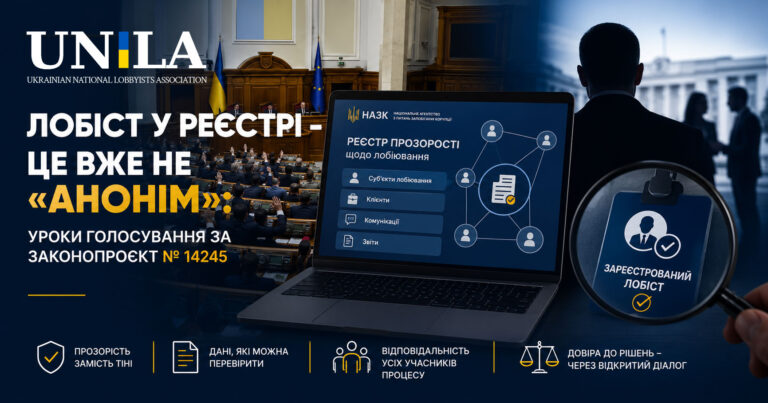
The enactment of the Law of Ukraine “On Lobbying” No. 3606-IX marked a key step in the institutionalization of lobbying activities in Ukraine. The law established a basic model of transparency through the creation of the Transparency Registry, which effectively serves as the sole source for verifying the status of a lobbying entity. It is the very act of being entered into this registry that constitutes the legal fact by which a person acquires the status of a lobbyist.
At the same time, it became clear even at the earliest stage of practical implementation that the model had a systemic flaw. The registry serves as an informational tool but does not provide any means of identifying a lobbyist in the real world. It lacks photographic data, and a significant portion of the information that could be used to verify a person’s identity is restricted to third parties.
This means that, in practice, a lobbyist has no document to present to a public official to confirm his or her status. Consequently, any interaction with government agencies that involves physical access or face-to-face contact falls into a legal gray area.
The situation is complicated by the fact that the law itself formally guarantees a lobbyist’s right to enter the administrative buildings of state and local government bodies. However, this right is formulated by reference to “the procedure established by law,” which in fact does not exist.
This gives rise to a classic regulatory gap: the law has been enacted, but the mechanism for its implementation has not been established. The official at the entrance to the institution lacks the means to verify compliance, while the lobbyist lacks the means to provide proof. As a result, decisions on admission may be made on a case-by-case basis, which leaves room for subjectivity and potential abuse.
The reasons for this situation lie in the structure of the law itself. The NACP’s functions as the administrator of the Transparency Register are limited to data management and do not include the issuance of any certificates or documents. At the same time, when the legislature introduced the provision on access to government agencies, it failed to establish the necessary procedural framework, leaving this issue unresolved.
Another factor is the novelty of the institution of lobbying itself in Ukraine. Many aspects of how it operates—including identifying the locations where lobbying activities take place—became apparent only after the system was launched.
Against this backdrop, the issue of identification ceases to be a mere technical detail and takes on systemic significance. It directly affects the level of access to government bodies and creates the risk of informal practices emerging, in which only “well-known” or “approved” entities are granted actual access.
In this context, an analogy with the legal profession is instructive. In this field, identification is based on a combination of a registry and a license that has independent legal force. This model makes it possible to quickly confirm a person’s status—without additional checks—in any situation involving interaction with the government.
At the same time, even this institution demonstrates that separate legislative regulation is necessary for the digital representation of an ID card in “Diia.” This means that, from a lobbyist’s perspective, the issue of digital identification cannot be resolved solely through technical means—it requires an explicit provision in the law.
In light of this, a phased approach to resolving the issue appears to be the most realistic option. In the short term, it would be advisable to expand the functionality of the current model by assigning the NACP the responsibility of issuing lobbyist certificates based on data from the Transparency Register and ensuring that these certificates can be displayed digitally. This will allow for the prompt closure of this practical gap without altering the institutional structure of the system.
At the same time, from a strategic perspective, it seems logical to move toward the creation of a fully-fledged lobbying self-governing body that could assume the functions of professional identification and regulation. This approach is consistent with European practices for the development of professional institutions, but it requires a separate legislative decision and time for institutional development.
In conclusion, it can be stated that current legislation has created the necessary framework for lobbying in Ukraine but has failed to provide one of its key elements—the ability to verify a lobbyist’s status in practice. The absence of such a mechanism not only complicates the work of lobbying entities but also creates conditions that distort the very idea of transparency.
That is precisely why the issue of identification should be viewed not as a technical refinement, but as a critically important element in the further development of the entire system for regulating lobbying activities in Ukraine.