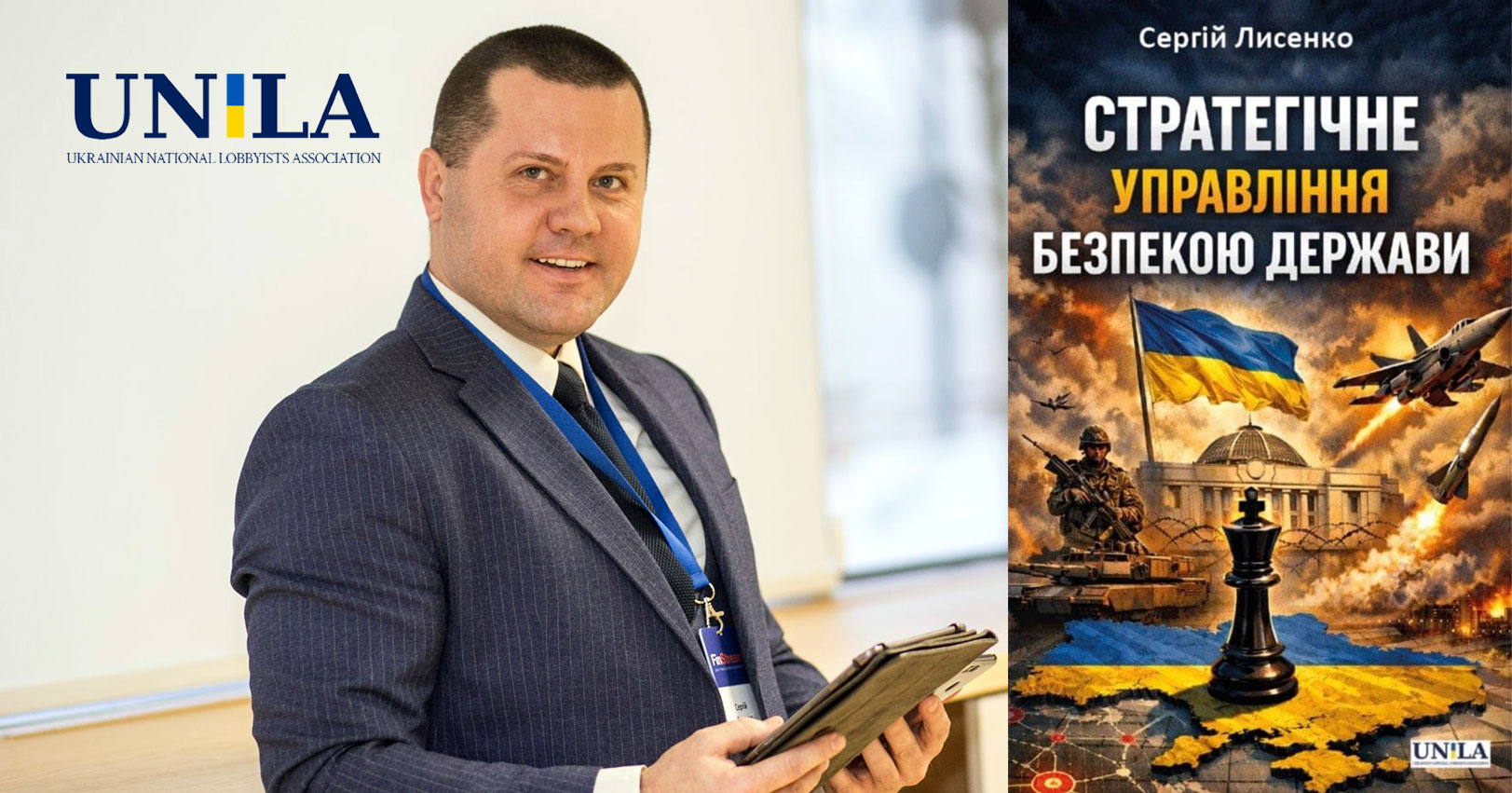
The Ukrainian National Lobbyists Association is also involved in the printing industry. Our first books have already been published
The book “Strategic Security Management” by Serhiy Lysenko, Chairman of the Board of Trustees of the Ukrainian National Lobbyists Association, is a thorough scientific and analytical study that forms a holistic vision of the modern national security architecture of Ukraine in the context of war, global turbulence and rapid digital transformation. The publication is distinguished by its systematic nature, conceptual depth, and practical orientation, which makes it a valuable contribution to the formation of a culture of strategic planning in the Ukrainian state.
The Ukrainian National Lobbyists Association considers this work to be an academic study combined with intellectual tools for shaping public policy, civic responsibility and strategic thinking in the context of the Russian-Ukrainian war.
The author convincingly demonstrates that strategy is not only a military term, but a universal category of complex systems management. The book traces the evolution of strategic thought from ancient treatises to modern models of information security management. Particularly valuable is the combination of historical and philosophical analysis with modern security realities. Serhiy Lysenko has consistently argued that the strength of the state lies in the combination of military potential and the ability to manage the security system comprehensively, integrating military, information, economic, political and legal instruments. This approach is in line with the modern understanding of the “grand strategy”, where war is seen as a component of the political process and information is a new form of power.
The book’s points are especially relevant in the context of the Russian Federation’s full-scale aggression against Ukraine. The author goes beyond theoretical generalizations and systematically analyzes the Russian-Ukrainian war as an example of a modern hybrid conflict in which information operations, psychological influence, manipulation of public consciousness, and the struggle for control over narratives play a key role. For Ukraine, strategic security management has ceased to be an abstract category and has become a matter of physical survival of the state. In this sense, the book becomes an intellectual response to the questions that arise during the war. The author emphasizes that modern warfare is waged not only on the front line. It covers the information space, the economic system, international diplomacy, internal political stability, and the moral and psychological state of Ukrainian society. Such a comprehensive approach allows the reader to understand that victory over the aggressor is impossible solely by force. An integrated strategy is needed, which should combine military resilience, international coalition policy, effective public administration, and the resilience of civil society.
From the point of view of the lobbying community, the author’s emphasis on the role of coalitions, alliances and international support is extremely important. Strategic management of the state’s security in wartime should include active international advocacy of Ukrainian interests, the formation of a positive image of Ukraine and countering Russian disinformation at the global level. It is strategic management that becomes the basis for effective international communication.
The book’s moral and value dimension deserves special attention. The author dedicates the work to the military, volunteers, and all defenders of Ukraine. This is not just an emotional gesture, but a strategic position. Ukrainian soldiers and officers in this war have become the bearers of a new security paradigm. They are simultaneously defending state sovereignty, shaping a new military culture, setting an example of civic responsibility, and becoming a moral guide for the entire Ukrainian society. From the perspective of strategic management, their contribution is a fundamental resource of the state, a resource of trust, legitimacy and national unity. No strategy works without the support of society. Without respect for soldiers, no security system has a moral basis.
The book convincingly shows that victory in modern warfare depends not only on technology or weapons, but also on the will of the people, their willingness to sacrifice, and their ability to act strategically.
The book’s potential to shape a new strategy for veteran support in Ukraine is particularly important. After the active phase of the war is over, the country will face a large-scale social challenge: the integration of hundreds of thousands of veterans into civilian life. If this process is spontaneous or formal, the state risks significant social tension, marginalization of veterans, loss of strategic human potential, and the growth of psychological and social crises. This is where the strategic approach proposed in the book becomes practical.
Veterans should be viewed as a strategic resource of the state. The author’s concept allows us to treat veterans not only as objects of social assistance. Veterans are seen as carriers of unique experience, community leaders, future effective managers, security experts and agents of social resilience. Veteran policy should be integrated into the national security system. This means that professional retraining programs should be created, veterans should be involved in the civil service and local government, veteran leadership institutions should be formed, and veteran entrepreneurship should be supported.
Strategic management involves taking into account the psychological factor. The traumatic experience of war requires a systemic state response and the specific creation of a network of psychological assistance centers, training of specialists and development of programs to support military families. Ignoring these aspects will create long-term risks for the internal stability of the state. Supporting veterans is now becoming a test of the state’s maturity. If a soldier who has defended the country does not receive proper support after returning from the front, it undermines trust in government institutions.The book creates a conceptual framework for the formation of veterans’ policy as a component of the state’s grand strategy – not a temporary social project, but a long-term system.
The Ukrainian National Lobbyists Association sees this book as a methodological basis for the development of effective state policy, as well as legislative initiatives in the field of security, veterans’ legislation and international advocacy of Ukrainian interests. Strategic security management should be accompanied by strategic lawmaking. It is necessary to improve the regulatory framework for social protection of veterans, create incentives for businesses to employ veterans, ensure transparency in the use of international assistance, and formulate a long-term concept for the reintegration of the military into civilian life. The lobbying community can become a bridge between veterans’ organizations, government institutions and international partners. Therefore, we are convinced that a strategic approach helps to avoid fragmentation and chaotic decisions.
Today, Ukraine is forming a new strategic culture – a culture of long-term planning, systemic thinking and responsibility for the future. Serhiy Lysenko’s book contributes to the intellectualization of the security discourse, shapes a new management paradigm, integrates historical experience and modern challenges, and lays the foundation for the strategic thinking of the post-war generation.The Ukrainian National Lobbyists Association recommends the book to civil servants, officers, security experts, legislators, community leaders, and representatives of veterans’ organizations.
“Strategic Security Management” looks like a scientific monograph and, at the same time, an intellectual guide for a state that is waging a war for its existence. The work substantiates the need for a comprehensive approach to national security, demonstrates the importance of the information component of war, honors the contribution of Ukrainian soldiers and officers, creates a conceptual framework for the formation of a modern veteran policy, and offers a strategic vision of Ukraine’s future.
The Ukrainian National Lobbyists Association highly appreciates the scientific and social significance of this work and recommends it for wide professional and academic use.
At a time when Ukraine is fighting for its freedom at the cost of the lives of its best sons and daughters, strategic thinking is a form of responsibility to future generations. It is books like these that form the foundation of a state capable not only of winning a war but also of building a just, sustainable, and socially responsible society.
Sincerely yours
Chairman of the Board of the Ukrainian National Lobbyists Association
Oleksiy Shevchuk