Toward the Professionalization of GR Management: UNLA Is Developing a New Profession for Modern State-Building
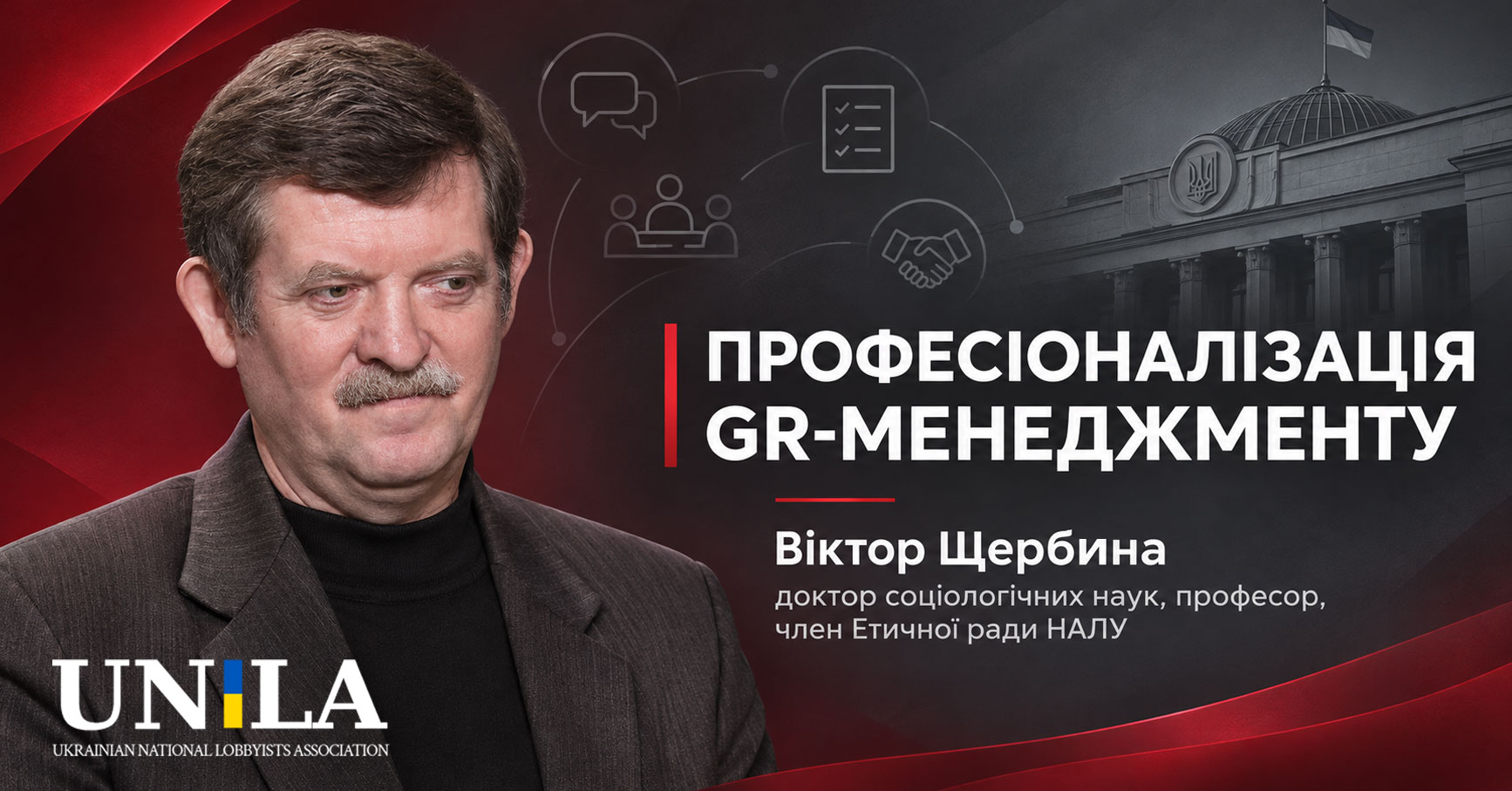
Author: Viktor Shcherbina — Doctor of Sociology, Professor, Member of the Ethics Council of the Ukrainian National Lobbyists Association
Modern Ukraine is going through one of the most critical periods in its history—war, postwar reconstruction, European integration, and digital transformation are placing new demands on the quality of public administration and civic dialogue. At the same time, the country is undergoing a natural generational shift among its state-builders—those who laid the foundations of independent Ukraine after 1991 are being succeeded a new generation of administrators, politicians, experts, entrepreneurs, and civic leaders is emerging—those who will determine the country’s development trajectory in the coming decades.
Generational change is always associated not only with new opportunities but also with certain risks. One of the main challenges is preserving institutional memory and ensuring the continuity of state-building experience. Ukraine already has a strong track record in the areas of building democratic institutions, developing local self-government, strategic communications, cooperation between the state and civil society, overcoming political crises, and implementing reforms; but there is a risk that this experience could be lost or devalued.
One potential risk is a situation in which, due to a shortage of domestic professionals and expert institutions, the development of strategically important decisions is effectively outsourced to external advisory centers. In such cases, even high-quality recommendations may fail to adequately take into account Ukraine’s historical experience, sociocultural characteristics, and long-term national interests. For example, when preparing reforms in the areas of economic policy, regional development, or post-war reconstruction, the priorities of international partners may objectively differ from the needs of individual Ukrainian communities, industries, or economic sectors. That is precisely why Ukraine must develop its own human and expert capacity, capable of participating as an equal partner in international dialogue and ensuring that decisions are made in line with national interests.
New historical conditions call for new approaches—growing global competition, information influence, and attempts at external interference in the process of formulating public policy underscore the need to strengthen Ukraine’s own agency. Preserving independence today means not only defending borders, but also the ability to shape its own governance practices, independently define national priorities, and make strategic decisions based on Ukrainian interests and Ukrainian experience.
That is precisely why the development of professional institutions that facilitate high-quality dialogue between the government, the business community, and civil society is becoming increasingly important. One such institution is government relations (GR) management, which in leading democratic countries serves as an important mechanism for stakeholder participation in the formulation and implementation of public policy.
Unlike the simplified notion of representing interests, modern GR management encompasses strategic communications, policy analysis, stakeholder engagement, advocacy, consultative processes, and the search for balanced solutions among different social groups. In its modern form, it contributes not only to more effective communication but also to improving the quality of government decisions.
For Ukraine, the professionalization of this sector is of particular importance, as it involves fostering a new culture of interaction between the government and society, based on transparency, integrity, expertise, and accountability. It is precisely this model that creates the conditions for harnessing society’s intellectual and creative potential in the process of nation-building and fosters the development of innovative solutions in response to the complex challenges of our time.
An important step in this direction was the development of a draft Professional Standard for “GR Managers,” on which a group of specialists is working in collaboration with experts from the Ukrainian National Lobbyists Association. The document is currently undergoing broad professional and public discussion.
The purpose of this standard is to define the professional competencies, job functions, qualification requirements, and ethical principles governing the work of GR professionals. Essentially, this involves creating a modern professional framework that will allow for the integration of international experience in government relations with the needs of Ukraine’s state and societal development.
This work takes on particular relevance in the context of the country’s postwar recovery. Effective collaboration among government institutions, businesses, communities, international partners, investors, and civil society organizations will increasingly depend on professionals capable of facilitating constructive dialogue, coordinating the interests of various stakeholders, and promoting the development of balanced solutions.
The digital transformation of the state is no less important. The spread of e-government, mechanisms of e-democracy, open data, and artificial intelligence tools creates new opportunities for citizens and expert communities to participate in the development of public policy. This requires new competencies and a new professional culture of interaction between the state and society.
We invite you to join the discussion
The Ukrainian National Lobbyists Association invites representatives of state and local government bodies, the business community, institutions of higher education, civil society organizations, think tanks, and experts in public policy, strategic communications, and advocacy to join the discussion on the draft “GR Manager” Professional Standard.
Today, more than just a new professional standard is taking shape. The foundations are being laid for a profession that is intended to become one of the mechanisms for the development of modern Ukrainian statehood, ensure effective dialogue between the government and society, and contribute to the formation of a new management culture that combines the best practices of independent Ukraine with the innovative approaches of the future.
We invite all interested professionals to submit their proposals, expert comments, and practical recommendations. A broad professional discussion will help us develop a high-quality standard that meets both international best practices and the needs of Ukrainian society.
Together, we’re shaping the future
The professionalization of GR management is not merely a matter of developing a new field of activity. It is a contribution to the formation of modern state-building mechanisms capable of ensuring Ukraine’s stability, independence, and competitiveness in the face of global challenges. By combining the accumulated experience of Ukrainian statehood with new knowledge and management practices, we are laying the foundation for the development of a state that not only responds to the challenges of our time but also independently shapes its own future.
Ukrainian statehood has always been shaped by society’s ability to combine the experience of previous generations with responses to new historical challenges. Today, one such challenge is the development of a modern culture of interaction between the government, business, and civil society. The professionalization of GR management is intended not only as a step toward the emergence of a new profession but also as a contribution to the development of Ukrainian agency, the strengthening of the state’s institutional capacity, and the harnessing of the nation’s creative potential to shape its future.