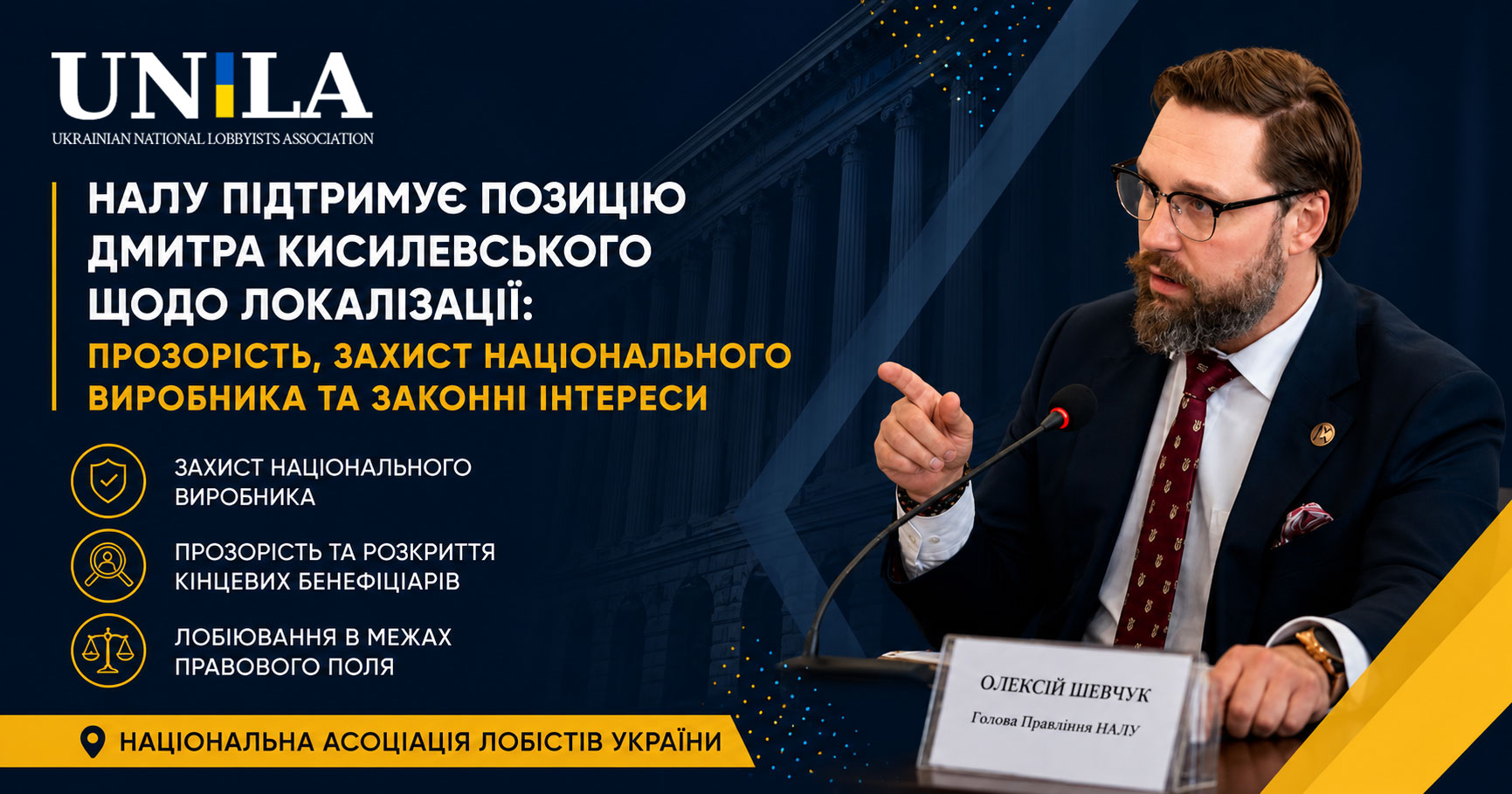
The Ukrainian National Lobbyists Association supports Dmytro Kysilevsky’s position on localization and emphasizes the need for transparent representation of interests
The Ukrainian National Lobbyists Association publicly supports the position of People’s Deputy Dmytro Kysilevsky regarding the protection of domestic producers, the development of localization mechanisms, and countering practices that may constitute unfair competition in the public procurement market.
Members of the association, who are professional lobbyists, have stated their readiness to help advocate for the legitimate interests of Ukrainian entrepreneurs, which are identified as priorities within the framework of the state’s economic policy.
Representatives of the professional lobbying community emphasize the need to disclose the ultimate beneficial owners of foreign business entities that participate in shaping industry positions and may directly or indirectly influence the development of public policy. Association representatives also express reservations regarding the European Business Association’s position on localization, which NALU does not support, and stress that the discussion on the advisability of localization should be conducted primarily with domestic manufacturers, not with importers.
“Made in Ukraine” Policy
Dmytro Kysilevsky, who is the author of legislative initiatives in the field of localization and the coordinator of the “Made in Ukraine” policy in the Verkhovna Rada, stated that the discussion on the advisability of localization should be conducted primarily with domestic manufacturers, rather than with importers, whose interests, he said, may conflict with the goals of developing domestic production. Requirements regarding the share of Ukrainian-made components in the procurement of products in certain industries were already in effect in 2025 and were strengthened in 2026.
According to the lawmaker, the localization mechanism has become one of the tools of the state’s industrial policy, aimed at supporting domestic manufacturers, preserving jobs, and preventing Ukrainian products from being excluded from public procurement.
Legal Context
In this context, the issue is not only one of economic feasibility, but also of ensuring legal safeguards for the principles of fair competition, equal access to participation in procurement, and the prevention of manipulation regarding the origin of goods. According to proponents of localization, the introduction of effective controls over compliance with the relevant requirements is intended to minimize the risk of abuse, particularly during participation in tenders through the formal declaration of Ukrainian origin for products.
The Ukrainian National Lobbyists Association, for its part, emphasizes that lobbying must be conducted within the legal framework, in accordance with the principles of transparency, accountability, and proper disclosure of information about influential entities. That is why the association stresses the importance of identifying ultimate beneficiaries when it comes to foreign entities involved in shaping public positions.