
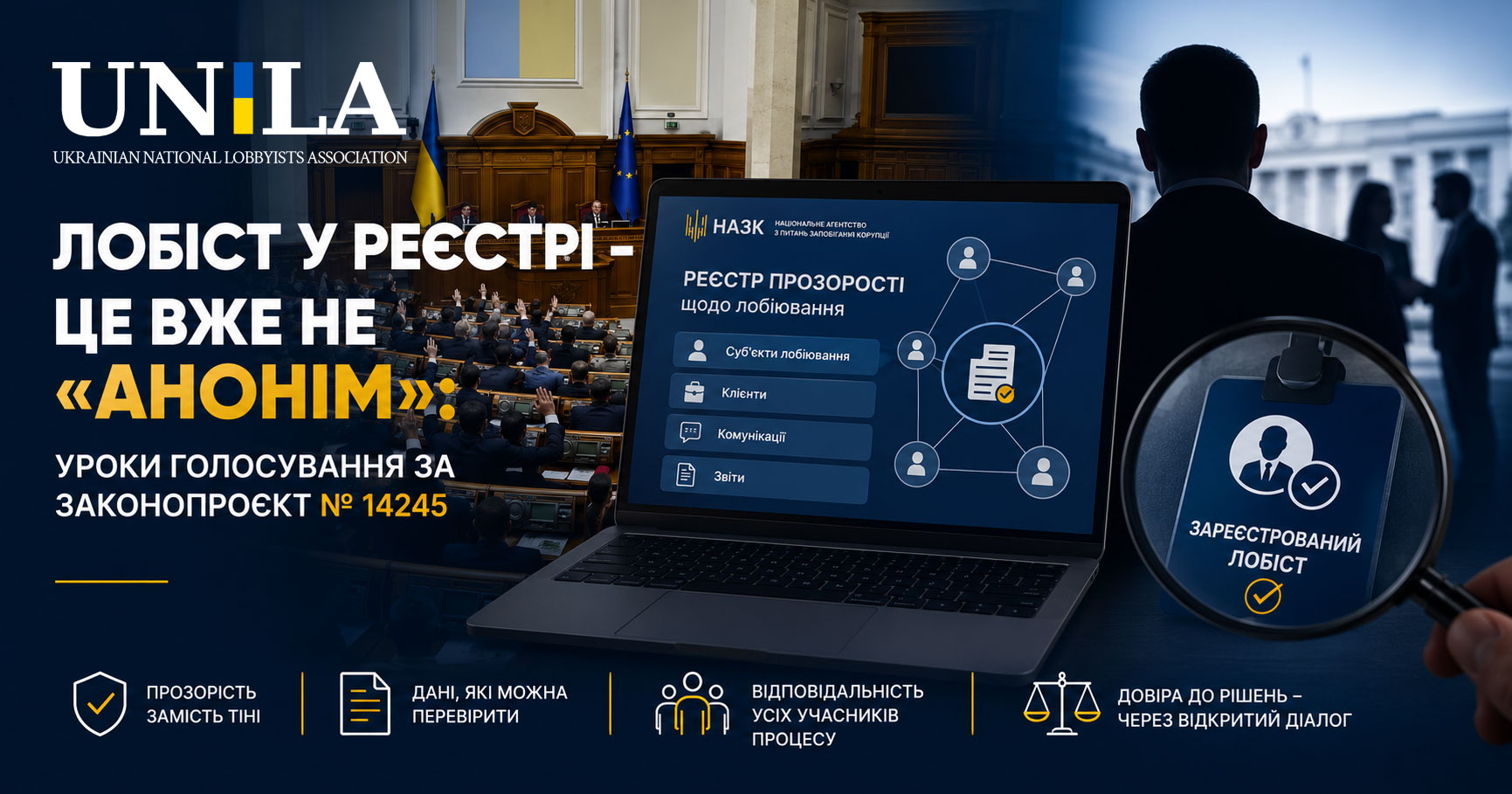
A Lobbyist Listed in the Registry Is No Longer “Anonymous”: How the Culture of Transparent Lobbying Is Changing in Ukraine
This is an article on Dmytro Buzanov’s blog on glavcom.ua —and it’s not just about a single vote in the Verkhovna Rada. It’s a story about how a new institutional reality is taking shape in Ukraine: lobbying is becoming more transparent, and claims of “anonymous influence” can increasingly be verified using official data.
The vote on June 10, 2026, on Bill No. 14245 was one of the first large-scale instances in which the public had the opportunity to compare public political statements with the information contained in the Transparency Registry. And this, without exaggeration, is one of the most important consequences of the enactment of the Law of Ukraine “On Lobbying.”
The Transparency Registry Is a Game-Changer
For a long time, the word “lobbyist” in Ukrainian society has been associated with informal influence, backroom deals, and unknown players. That is why one of the key objectives of the Law of Ukraine “On Lobbying” was to create a mechanism that makes the representation of interests transparent and accountable.
Today, a registered lobbyist is not an anonymous individual. Information about lobbying entities, their clients, areas of activity, communications, and reporting is made available to the public through the Transparency Registry.
This means that any claims regarding the influence on political decisions can be verified by facts, not assumptions.
From Political Rhetoric to Facts
The public debate surrounding certain bills shows that political culture has not yet fully adapted to the new rules.
The notion of “anonymous lobbyists” who allegedly influence decision-making is increasingly at odds with reality. If lobbyists are registered, their contacts are listed in the Transparency Registry, and communication takes place within the bounds of the law, the public is able to independently assess the nature of such influence.
This is precisely the main goal of transparent lobbying—not to restrict communication between business and government, but to make it open, understandable, and accountable.
Transparency Requires a New Culture
The launch of the Transparency Registry is just the first step.
For the new institution to function effectively, it is necessary to foster a culture of collaboration among members of parliament, government agencies, the business community, lobbyists, and civil society.
This applies not only to technical compliance with the law, but also to public communication, the proper use of data from the Registry, an understanding of the boundaries of lawful lobbying, and the differences between transparent advocacy and covert influence.
The Role of Vocational Education
That is why one of the priorities of the National Association of Lobbyists of Ukraine and the Higher School of Lobbying is professional education in the field of lobbying and advocacy.
Organizing training sessions, roundtables, and professional discussions involving members of parliament, government officials, business representatives, and experts will help foster a shared understanding of the new rules.
Conclusion
The Transparency Registry is neither a tool for targeting businesses nor a mechanism for exerting political pressure.
This is a new language of interaction between the government and society, in which every participant in the process can openly represent their interests, and citizens can see who is influencing public decisions, how, and for what purpose.
And the success of lobbying reform in Ukraine will depend precisely on how quickly the Ukrainian political and professional communities adapt to this culture of openness.
Dmytro Buzanov, attorney, lobbyist, member of the Ukrainian National Lobbyists Association