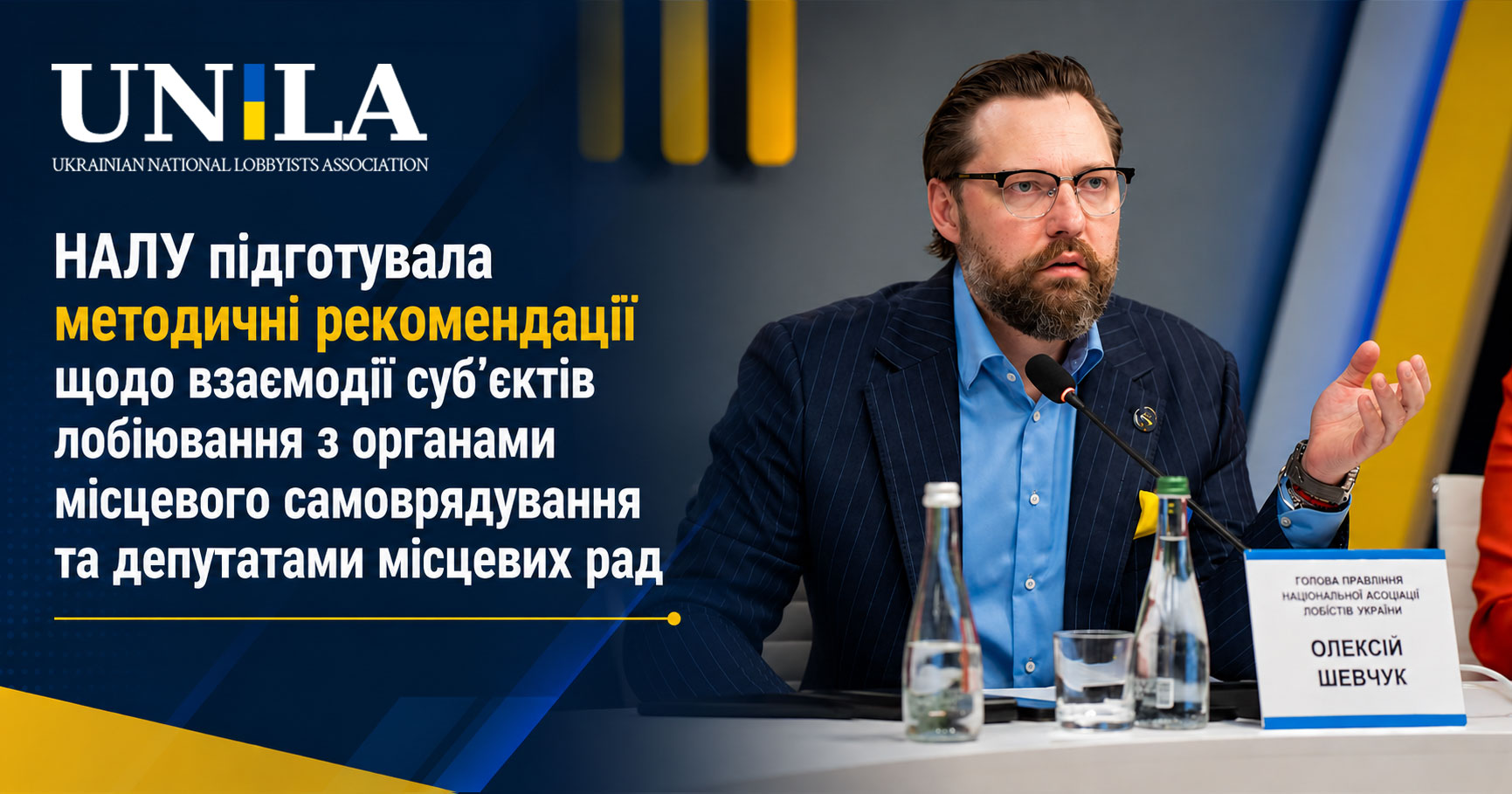
The Ukrainian National Lobbyists Association has prepared guidelines on how lobbying entities should interact with local government bodies and local council members
One of the key achievements of the Ukrainian National Lobbyists Association is the development of Guidelines on the Interaction of Lobbying Entities Registered in the Transparency Registry with Local Government Bodies and Local Council Members.
This document was developed as a follow-up to the “Lobbyist–Local Council/Local Government” Roadmap for Interaction presented by UNLA. The roadmap outlines seven sequential stages of transparent interaction: from the initial contact and identification of the lobbying entity to the consideration of proposals, the adoption of a corresponding decision, monitoring of its implementation, and assessment of the consequences for the community, businesses, and other stakeholders.
The Ukrainian National Lobbyists Association continues its systematic efforts to build a professional community and implement transparent, ethical, and legally defined rules for lobbying.
As a professional platform that brings together lobbyists, lawyers, academics, representatives of the business community, the civil society sector, and public authorities, UNLA develops methodological guidelines, practical procedures, and explanatory materials. Their goal is to promote a unified approach to understanding and applying lobbying legislation in practice, as well as to minimize legal, corruption, and reputational risks for all parties involved in relevant legal relationships.
Recommendations as a Practical Tool for Applying the Law
The recommendations prepared by UNLA are of a methodological and explanatory nature. They are not a regulatory act, do not establish new rights or obligations, and do not supersede the official interpretation of the law by authorized state bodies.
At the same time, the document systematizes the provisions of the Law of Ukraine “On Lobbying,” anti-corruption legislation, legislation on local self-government, the status of local council members, and the Rules of Ethical Conduct for Lobbyists. On this basis, clear and practical mechanisms for interaction between lobbyists, council members, and officials of local self-government bodies are proposed.
The recommendations are based on the principles of legality, openness, transparency, integrity, equal access, and accountability. During professional interactions, a lobbyist must properly identify themselves, disclose that lobbying is taking place, identify the client or beneficiary, specify the scope and subject matter of the lobbying, and indicate the specific regulatory act or draft regulatory act that is the target of the influence.
Special attention is given to the legal distinction between lobbying and other lawful forms of interaction with public authorities. Not every appeal by a citizen, a business representative, or a civil society organization to a local council constitutes lobbying. To correctly classify such actions, it is necessary to assess the substance of the activity: who is exerting influence, in whose interests they are acting, whether a commercial interest is involved, and whether the interaction relates to a specific regulatory act.
Citizen appeals, electronic petitions, public hearings, public consultations, scientific and expert activities, the defense of one’s own rights, and the representation of the public interest—provided there are no indications of paid promotion of another party’s commercial interests—should not automatically be equated with lobbying.
A Guide for Legislators and Public Officials
For representatives of local government bodies, UNLA offers a step-by-step procedure. It involves checking for signs of lobbying, verifying a person’s status in the Transparency Register, properly identifying the client or beneficiary, determining the subject of the lobbying, and documenting substantive contacts.
The law does not require local council members or officials to submit separate, special reports on their contacts with lobbyists. However, to ensure transparency and preventive safeguards, the recommendations propose maintaining an internal contact log. This log may include the date and format of the meeting, participants, the client or beneficiary, the subject of lobbying, the draft decision, materials provided, and potential risks.
Such record-keeping does not create any additional legal obligation, but it helps ensure that communications are properly documented, prevents conflicts of interest, and confirms the integrity of all participants’ actions.
The recommendations also include practical guidelines on permissible lobbying methods, reporting requirements for lobbyists, how to respond to attempts at covert or unregistered influence, as well as how to act in the event of an offer of an improper benefit, pressure, concealment of the beneficiary, or the provision of false information.
Certain sections of the document are addressed to citizens and business representatives. For businesses, two main legal formats for interacting with local authorities are defined: open participation in consultations and working groups in one’s own name, or engaging a registered lobbying entity to professionally represent commercial interests.
Developing Consistent Professional Practices
The development of such materials is part of UNLA’s broader efforts to build a responsible professional community of lobbyists in Ukraine. The Association creates a space for professional dialogue, the identification of practical challenges, the exchange of experiences, and the development of clear models of conduct in situations that are regulated by law only at a general level.
The proposed recommendations can be used as a basis for internal guidelines for local government bodies, training programs, checklists for council members and officials, contact logs, as well as informational materials for businesses and citizens.
UNLA will continue to work on providing methodological support for professional activities, developing ethical standards, and establishing consistent practices for applying legislation in the field of lobbying. After all, transparency in this area depends not only on the existence of legal provisions, but also on the extent to which all participants in the process understand and apply them consistently, professionally, and in good faith.
The following individuals contributed to the preparation of the Methodological Recommendations: Vitalia Hloba, a representative of the Ukrainian National Lobbyists Association; Volodymyr Bondarenko, an expert and member of the Kyiv City Council; Yaroslav Kuts, an attorney, lobbyist, and chairman of A.Dva.Ka.T” Law Firm; Yaroslav Kuts, a member of the Committee on Lobbying of the National Bar Association of Ukraine; Ivan Fursenko, Vice President of the Congress of Local Self-Government of Ukraine; Vadym Vashchenko, member of the Ethics Council of the Ukrainian National Lobbyists Association and member of the Sumy Regional Council; Violetta Sukhanova, lobbyist, member of the Ethics Council of the Ukrainian National Lobbyists Association, and expert on conflicts of interest and strategic interaction between business and the state; Valeria Golovanova, lobbyist and member of the Entrepreneurs’ Council attached to the Sumy City Council; and Yana Tsymbalenko, Anti-Corruption Commissioner of the Ukrainian National Lobbyists Association.