

Lobbying in Local Government: On the Distinction Between Public and Commercial Interests
Volodymyr V. Bondarenko — a civil servant, secretary of the Kyiv City Council of the 9th convocation, and former advisor and deputy mayor of Kyiv.
In this research paper, the author analyzes the practical challenges of implementing Ukraine’s Law “On Lobbying” at the local government level and proposes ways to improve the current legislation.
The law exists, but lobbying is largely outside the law
The history of legislative regulation of lobbying in Ukraine has been a long and uneven one. For years, this topic remained on the margins of public discourse: in the public consciousness, the term “lobbying” was associated exclusively with corruption schemes, rather than with a legitimate tool for representing interests, as it is in most developed democracies. At the same time, Ukrainian legislative practice in this area developed without systematically taking into account either the European or American models of lobbying regulation, nor the findings of domestic legal scholarship, which for decades had studied this institution primarily in theory, without any actual legislative implementation.
The Law of Ukraine “On Lobbying” No. 3606-IX, which took effect in the fourth quarter of 2025, marked the first attempt to move beyond purely theoretical debate. Its adoption can rightly be considered a compromise—between the objective need to regulate the institution of lobbying, the historically negative public attitude toward it, and the expectations of the professional community, which for years had insisted on the legalization of this activity. However, like any compromise, this law is not without its internal contradictions. It raises a number of questions, the answers to which will not only lie in the realm of law enforcement practice but will also inevitably give rise to the need to amend the law itself.
This is the premise underlying the academic study by Volodymyr Bondarenko, secretary of the Kyiv City Council, published in the journal “Current Issues in Economics.” The author emphasizes that research into regulating the institution of lobbying in Ukraine is relevant today and will remain so even after active hostilities end and the country transitions to postwar reconstruction. Moreover, the influx of foreign capital into Ukraine—an inevitable scenario for postwar reconstruction—will undoubtedly require clear and understandable lobbying rules, particularly within local self-government bodies. In other words, local government bodies and officials must now have consistent legal application and predictable judicial practice regarding the problematic issues of this institution—and it is precisely the lack of such stability that is the subject of this study.
The central question the author poses is extremely specific: Is the current law capable of distinguishing between actual lobbying influence on local government bodies and those forms of communication that merely do not formally meet its criteria, even though, in essence, they pursue the same goal—the promotion of private or corporate interests? The answer the researcher provides—based on an analysis of the Transparency Register, the practices of the Kyiv City Council, clarifications from the National Agency for Corruption Prevention, and a broad body of academic literature—is disappointing: a significant portion of actual lobbying in Ukraine remains outside the legal framework—in the very “gray zone” that the law was supposed to eliminate.
Current State of Research on the Issue
It is worth noting that the issue of lobbying in public authorities and local self-government bodies has become the subject of truly active academic research in recent years, especially in the context of the adoption of the Law of Ukraine “On Lobbying.” The theoretical and legal foundations of the institution of lobbying, its conceptual framework, and the specifics of its functioning within the public administration system have been examined in the works of D. Chernokhatnyi, I. Bovsunivska, V. Kravchuk, O. Volokhov, I. Garkavyi, and S. Retynskyi. Significant attention has been devoted to the organizational and legal framework for lobbying, the problems of shadow lobbying, and the mechanisms for its implementation in Ukraine in the doctoral dissertations of N. Berezka and D. Lubinets. Specific aspects of the classification of types of lobbying activities and the relationship between economic, civic, professional, and political lobbying are explored in the work of O. Kushnirenko and O. Dyagilev. International practices and models for conducting lobbying activities are analyzed in the works of M. Palanitsa, as well as in international analytical documents, particularly in the annual Open Budget Survey.
At the same time, as the author rightly notes, the issue of distinguishing between public and commercial interests in the field of lobbying—especially at the local government level—remains under-researched. Certain aspects of the category of “public interest” have been explored in the works of M. Savchyn, M. Kryvoruchko, D. Marits, and A. Shcherbyna; but there is currently no comprehensive study of the relationship between public interest, advocacy, and lobbying under Ukraine’s current legislation. This new study is intended to fill precisely this gap.
Transparency Registry: Numbers That Say More Than Meets the Eye
A formal indicator of the state of affairs in the field of legal lobbying is the Transparency Registry, which is maintained by the National Agency for the Prevention of Corruption. As of the end of May 2026, only 183 lobbying entities were registered in it. The small number of entities included in the registry points to a number of systemic problems that currently remain unresolved.
The vast majority of registered entities are individuals. Among legal entities, business entities predominate, while law firms and business associations—which are traditionally considered “classic” lobbying players in the European and American models—are represented by nearly one-third as many.
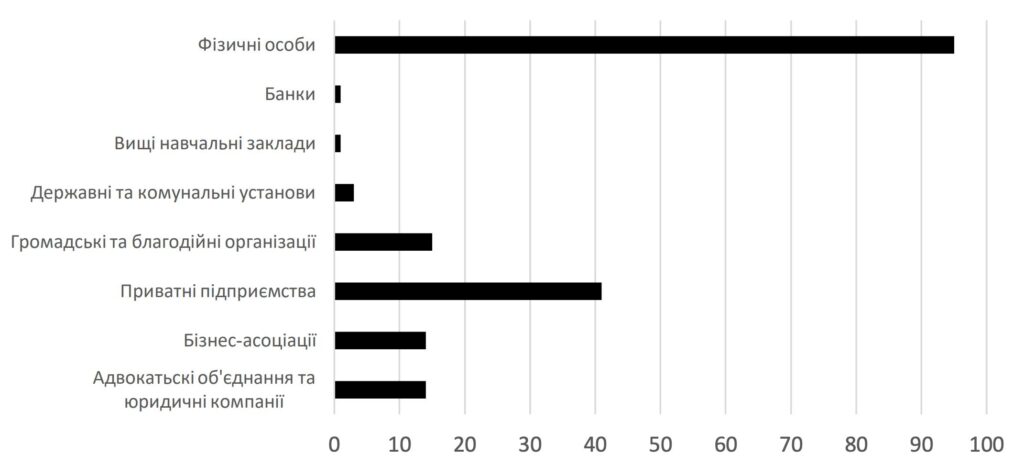
The author suggests looking at these figures from two perspectives, both of which are equally valid. On the one hand, this can be interpreted optimistically: Ukrainian businesses are ready to lobby for their own commercial interests independently, without involving intermediaries, and openly declaring their activities in the official registry. On the other hand, one could also point to a lack of professional lobbying entities willing to operate within the “legal framework” in accordance with the law, as well as a trend toward lobbying entities predominantly operating as self-employed individuals rather than as institutional market players.
At the same time, there is no clear consensus on the introduction of a professional standard for “lobbyists” in Ukraine, and this is a source of tension within the professional community. The Ukrainian National Lobbyists Association has begun developing such a professional standard, viewing it as a logical and necessary step toward professionalizing the industry, increasing public trust in it, and establishing clear qualification guidelines for those who wish to work legally in this field. At the same time, a number of major business associations and business representatives have issued a statement claiming that its introduction is premature, and the National Agency for Corruption Prevention has effectively endorsed this more cautious position.
The author of the study draws attention to an important practical aspect of this discussion: in practice, for any government agencies or officials, the presence or absence of a professional standard is unlikely to pose a significant obstacle to communicating with lobbyists—if a person is registered in the Transparency Register, their activities are already carried out in accordance with a special law. However, the absence of a professional standard reduces the practical ability to distinguish lobbyists from other specialists in the field of government relations, and thus creates an additional “gray area” in legislative regulation. The practical distinction between lobbyists and specialists in the fields of GR (government relations) and GPR (public relations with government agencies) is not only a practical but also a theoretical problem that still lacks a clear solution in the academic literature.
The Pitfall of a Narrow Definition: Why “Commercial Interest” Is Not the Whole Story When It Comes to Lobbying
It is against this backdrop, the author notes, that the main challenge for local self-government is determining the actual purpose of communications by individuals listed in the Transparency Registry. The special law explicitly states that activities that do not meet all the legal criteria for lobbying are not considered lobbying. Consequently, the presence or absence of the protection of a commercial interest derived specifically from economic activity becomes the defining factor that distinguishes lobbying from other types of communication with government authorities.
At the same time, although the National Agency for Corruption Prevention interprets “commercial interest” quite broadly, it nevertheless unequivocally links it specifically to the conduct of commercial—and not any other—activities. When combined with the subject of lobbying—which the law defines exclusively as a regulatory act and the set of actions related to its planning, adoption, amendment, or repeal— the legal regulation of lobbying in Ukraine turns out to be significantly limited—much narrower than required by the actual complexity of social relations in which influence is exerted on the government.
The author traces the contradictions of this approach using examples from European countries as well as the United States and the United Kingdom, drawing on a comparative analysis of international practices, particularly data from the annual Open Budget Survey. In international practice, the key challenge remains distinguishing between the commercial interests pursued by a business entity through its core activities and those pursued outside of them, in related areas of activity. Unfortunately, Ukrainian law does not resolve this problem; rather, it effectively perpetuates it in the narrowest possible form.
The first prime example cited by the researcher is the social projects and programs implemented by Ukrainian businesses. Such initiatives undoubtedly have a real social impact, but they also serve to advertise or promote the relevant brands, and thus directly affect the company’s commercial activities. However, lobbying for regulatory acts or specific municipal programs necessary for the implementation of such social projects would not formally constitute lobbying under a special law—even though the purpose of such influence is quite obvious.
A second example is lobbying by labor unions for certain regulatory and legal acts. This also directly affects the commercial activities of business entities whose interests the union effectively protects; however, it would not constitute lobbying under a specific law, since, formally, the union does not engage in economic activity as defined by law. Consequently, such de facto lobbying remains in a “gray area” of Ukrainian law—it exists, influences decisions, but does not legally exist within the regulatory framework.
The third—and perhaps the most telling—example concerns the very subject of lobbying, which is limited exclusively to normative legal acts. As the author notes, practices in other countries often recognize that the subject of lobbying is specifically executive acts—that is, acts of individual application—rather than merely general regulatory documents. The author finds confirmation of this directly in the Transparency Register, where one business entity openly declares that it is lobbying for changes to traffic organization near its shopping complex. Undoubtedly, the purpose of such actions is to advance commercial interests arising from the business entity’s own economic activities. However, this issue is not resolved by the adoption of a regulatory act—local councils and their executive bodies resolve such issues through individual administrative acts, which formally fall outside the scope of lobbying as defined by law.
Another case cited by the author is more complex—an organization lobbying for the adoption of a government resolution on a pilot project for long-haul truck trains. After reviewing the draft of this resolution by the Cabinet of Ministers of Ukraine, the researcher concludes that the pilot project in question will also not apply to an unlimited group of people—a mandatory feature of a regulatory act, — since it contains specific coordinates of the departure points where the facilities of the aforementioned business entity are located. However, the implementation of the company’s idea through a pilot project at the level of a government resolution does, formally speaking, more closely meet the legal criteria for lobbying than the previously cited example involving local traffic management. This clearly demonstrates how unevenly and inconsistently the current legal framework covers essentially similar situations—depending solely on the formal level at which a decision is made, rather than on the actual nature of the influence exerted on it.
Scientific Approaches to Covert Lobbying: No Consensus, but a Single Trend
A distinct and highly valuable aspect of this study is the systematization of scholarly approaches to understanding covert lobbying—a phenomenon that has been studied in Ukrainian academic literature for some time but has yet to receive a single, universally accepted definition.
For example, researcher D. Zayets links covert lobbying to circumventing legislative restrictions, particularly by involving company executives—who are not formally designated as government relations specialists—in direct communication for commercial purposes. O. Kushnirenko and O. Dyagilev view covert lobbying more broadly—as covert, improper, professional, religious, or informal influence on the decision-making process, emphasizing the variety of forms such influence can take. D. Lubinets focuses on the concealment of the true purpose of influencing public authorities through the misuse of the capabilities of citizens and the Ukrainian state as a whole. N. Berezka views this phenomenon as an effort to conceal the true purpose of influence through the same range of actors—citizens, organizations, and the media—emphasizing the systematic and recurring nature of such practices in the Ukrainian context.
Academic perspectives on hidden lobbying, summarized by the author based on
| Researcher | Approach |
| D. Zayets | The author notes that lobbying is carried out by civil society organizations and professional associations, including those without a clearly defined commercial interest. |
| O. Kushnirenko, O. Dyagilev | The authors distinguish between political, civic, professional, and religious (denominational) lobbying, alongside economic lobbying. |
| D. Lubinets | The author notes the widespread prevalence of shadow lobbying in Ukraine, particularly through nongovernmental organizations and the media. |
| N. Berezka | The author identifies the existence of shadow lobbying in Ukraine, including through nongovernmental organizations and the media. |
Thus, an analysis of scholarly approaches to understanding covert lobbying reveals that there is no single approach to defining its forms, actors, and methods of implementation. At the same time, most researchers agree that lobbying influence can be exerted not only through the direct representation of commercial interests, but also indirectly—through the activities of civic associations, professional unions, nongovernmental organizations, the media, and other civil society institutions. This approach confirms that modern lobbying extends far beyond the purely economic sphere and can take on political, professional, civic, or even religious forms — whereas Ukrainian law continues to view lobbying primarily as a direct and immediate byproduct of economic activity.
Online Petitions: When a Civic Initiative Is Actually a Business Strategy
In practice, the author notes, local government bodies encounter this kind of covert lobbying on an almost daily basis. The most practical and, at the same time, most telling part of the entire study is the empirical analysis of the Kyiv City Council’s online petition website, which provides evidence of systematic covert lobbying disguised as public interest.
The author cites specific examples of recent petitions which, in his view, unquestionably serve commercial interests, despite their outwardly civic nature. Among them is a petition against the repurposing of the “Metrograd” retail space, which formally appears to be concerned with preserving the integrity of public space but in fact protects the interests of specific tenants or owners of retail spaces. Several petitions concern the introduction of a moratorium on the removal of small architectural structures (MAS) in Kyiv—one of them even explicitly argues that, instead of removing MAS, funds should be directed toward elevator repairs, while another links the moratorium to martial law and the capital’s energy independence. Formally, these initiatives address issues of public importance—energy independence and social infrastructure—but their real beneficiaries are the owners of temporary commercial structures, whose business operations are threatened by demolition.
Another example is a petition calling for the restoration of a private market that was damaged by a rocket attack, and a petition calling for the procurement of a life-saving medication for patients with spinal muscular atrophy. The latter example is particularly telling because of its complexity: on the one hand, it involves a clearly humanitarian and socially important goal—patient access to life-saving medications. On the other hand, the author points out that such petitions can simultaneously serve as a tool to advance the interests of specific pharmaceutical suppliers or distributors interested in government procurement of the drug in question. It is precisely this type of ambiguity that makes distinguishing between public and commercial interests so difficult in practice.
Overall, based on the results of a systematic analysis of the Kyiv City Council’s e-petition website, the author reaches the following quantitatively verified conclusion: 22% of all petitions currently in the signature-collection stage and 64% of successful e-petitions directly or indirectly relate to the commercial interests of business entities. In contrast, only 10% of all e-petitions and 29% of successful ones exhibit formal characteristics that would meet the criteria for lobbying under a specific law. The gap between these figures represents the empirically measured extent of the “gray area” in Ukrainian lobbying: commercial interests are present in the overwhelming majority of high-profile petitions, while formal signs of lobbying are evident in only a small fraction of them.
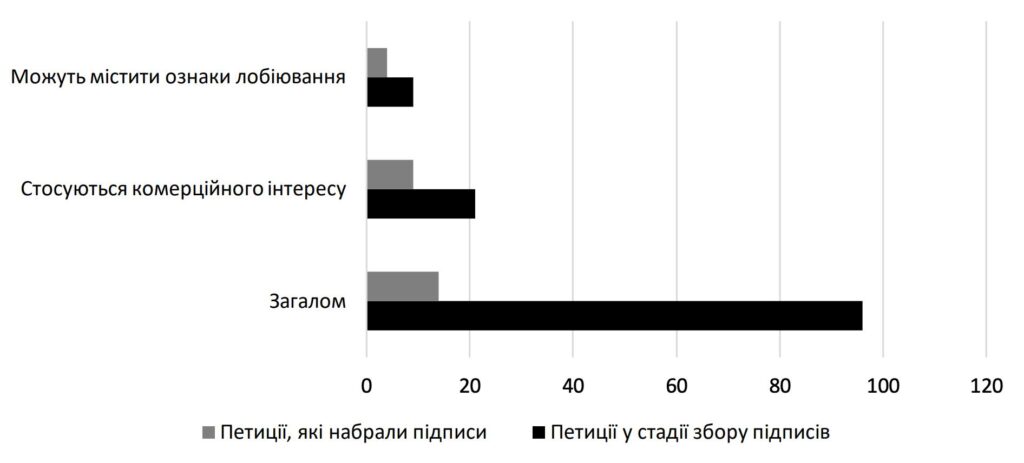
signs of commercial interest, May 2026, summarized by the author
The reason for this disconnect is a specific provision of the law. A special law explicitly excludes the creation and signing of electronic petitions from the realm of lobbying. Subsequently, such petitions are reflected in media discourse, shaping public attitudes toward the ideas they contain—a technique characteristic of so-called “outsider” lobbying strategies, which are well documented in international academic literature. However, Ukrainian lawmakers not only exclude media-related activities but also the media itself as an institution from the scope of lobbying. In other words, two key components of a typical outsider strategy—the petition and its subsequent amplification through the media—are excluded from regulation by law.
In the author’s view, this is not merely a technical loophole but a systemic flaw: the actual mechanism for influencing the decisions of local government bodies operates precisely through this chain—“petition → votes → mandatory consideration → media coverage”— while the law regulates only the final, least frequently used element of this chain—the direct representation of commercial interests before an official.
Public Interest: A Concept That Does Not Exist in Law
The issue of commercial interests of business entities, which forms the basis of a special law, should, in the author’s view, be clearly and unambiguously regulated in order to prevent abuses during advocacy campaigns. However, this is where perhaps the most fundamental conceptual gap in the entire study arises: the absence of a definition of “public interest” in Ukrainian legislation leaves ample room for manipulation of this term.
In search of a legal framework, the author turns to the case law of the Supreme Court, which, in particular, has defined the public interest as the needs of society or its individual groups that are related to the preservation, enhancement, and protection of existing values, the devaluation and/or loss of which would have a significant negative impact on the development of civil society. This judicial interpretation, although formulated in a different legal context, provides a useful starting point for understanding a concept that is lacking in the specific law on lobbying.
The author also summarizes the views of Ukrainian scholars who have studied the concept of the public interest in various sectoral contexts. M. Savchyn viewed the public interest as a criterion for restricting human rights, particularly in the context of combating the coronavirus pandemic. M. Kryvoruchko examined the problem of defining the essence of the concept of “public interest” in the context of the ethical component of the work of accountants and auditors. D. Marits analyzed the concept of “public interest” in information law relations. A. Shcherbina examined the relationship between the public interest and the protection of personal data within the framework and priorities of pandemic regulation. Despite the different sectoral contexts of these studies, all the authors mentioned agree on a key thesis: in contrast to private interest, public interest is general and impersonal.
It is precisely this distinction—the general and impersonal nature of the public interest, as opposed to the specific and targeted nature of the private interest—that, in the researcher’s view, should form the basis for distinguishing between advocacy and lobbying, regardless of the range of actors involved or whether or not they engage in economic activity. In other words, the criterion should not be who exerts influence (a business, a civil society organization, or an individual), but rather in whose favor and in whose interests that influence is exerted: in favor of an undefined group of people or in favor of a specific, individual beneficiary.
The problem is that this is a doctrinal guideline developed by academia and, to some extent, judicial practice, rather than a provision of positive law. Until a legislative definition of “public interest” appears directly in the text of the Law of Ukraine “On Lobbying” or related legislation, distinguishing legitimate advocacy from covert lobbying will remain a matter of academic debate and subjective legal interpretation, rather than a clear, predictable legal test.
Advocacy vs. Lobbying: Why Legal Status Is a Flawed Criterion
In developing this argument, the author specifically emphasizes the importance of distinguishing advocacy from lobbying based precisely on the nature of the interest, rather than on formal characteristics of the entity. This is a fundamentally important point, since both among experts and in the practice of government agencies, a simplified approach is quite common: if the entity exerting influence is a business or an economic entity, it is lobbying; if it is a civil society organization or an individual, it is advocacy.
The study convincingly demonstrates the fallacy of such a simplistic distinction. First, businesses may well initiate or support campaigns aimed at protecting values that are truly important to society—for example, combating environmental pollution, supporting educational initiatives, or developing urban infrastructure—where commercial gain is merely an indirect, secondary goal rather than the primary one. Second, as demonstrated by the example of online petitions, civic initiatives purportedly launched in the public interest may in fact serve as a direct tool for protecting narrow private or corporate interests—simply through the mediation of a formally “neutral” entity.
Therefore, the criterion proposed by the author—the nature and specificity of the interest, rather than the status of the initiator—appears to be significantly more productive for practical application, although it requires legislative codification in order to cease being merely a doctrinal construct.
Lobbying Methods: Freedom of Strategy Within the Bounds of the Law
Separately, the author emphasizes an important methodological caveat: the mere existence of a commercial interest should not entail restrictions on lobbying methods. Lobbying methods and strategies—whether insider or outsider, direct or indirect, public or behind-the-scenes—are determined by the professional strategy of a specific lobbyist or company and, as a general rule, must remain strictly within the bounds of the law. The state, the researcher emphasizes, should regulate the transparency and boundaries of lobbying—that is, who exerts influence, for what purpose, and at whose expense—but should not interfere with the choice of a specific communication strategy as long as that strategy remains within the bounds of the law.
This is a principled position that is consistent with established international practice: regulation of lobbying in developed democracies has traditionally focused on transparency (who is lobbying, whom, for what purpose, and with what funds), rather than on substantive control over the specific communication tactics a lobbyist uses.
International Context: Why the Ukrainian Model Is More Limited Than Its Global Counterparts
The author’s comparative analysis, based on the experience of the EU, the U.S., and the U.K., as well as data from international studies such as the Open Budget Survey, shows that: in the vast majority of developed jurisdictions, the definition of the subject matter and parties involved in lobbying is significantly broader than in Ukrainian law. In particular, international practice more often recognizes as the subject of lobbying not only legislative acts in the classical sense, but also administrative decisions, regulatory acts, budgetary decisions, and even specific managerial actions by government agencies — that is, precisely the category of acts of individual application that Ukrainian law excludes from its scope of regulation.
Furthermore, international models more often consider indirect forms of influence—through civic coalitions, think tanks, and media campaigns—as potential subjects of disclosure, whereas Ukrainian law explicitly excludes the media and civic initiatives from its scope of regulation. This creates a situation where the Ukrainian lobbying model, despite the formal existence of a specific law, remains conceptually narrower and less responsive to the actual mechanisms of influence on the government than similar models that have already stood the test of time in other jurisdictions.
What does this mean for practice and for the professional community?
The findings of the study have direct practical significance for several audiences at once.
This is an important warning for local governments: a significant proportion of the requests, petitions, and even what appear at first glance to be social initiatives that they deal with on a daily basis may have hidden commercial motivations, even though they do not formally fall under any procedural requirements of the lobbying law. Officials should develop their own internal guidelines for assessing the nature of such appeals—even in the absence of a legislative definition of the public interest—by relying at least on the doctrinal criterion of non-personalization proposed in the study.
For the National Agency for Corruption Prevention, the study’s findings provide a compelling argument for revising the approach to defining the scope of lobbying—expanding it to include individual actions and administrative decisions, as well as formulating a clearer definition of commercial interest that would take into account indirect forms of benefit—such as reputational, promotional, and industry advantages—which do not always directly translate into profit but directly influence a business entity’s competitive position.
For the professional lobbying community—in particular, the Ukrainian National Lobbyists Association — the study’s findings provide an additional and compelling argument in favor of a consistent position: transparency in the lobbying sector is possible only when the law covers actual mechanisms of influence, rather than just their most obvious, formal economic form. As long as a significant portion of actual lobbying is disguised as petitions, social initiatives, or media campaigns, the institution of lobbying itself will bear the brunt of the reputational damage: the public will continue to view the very word “lobbying” in an exclusively negative light, while the few entities that operate transparently and legally—and are registered in the Transparency Registry—remain a clear minority among those who actually influence government decisions.
This is a matter of fundamental importance for the reputation of the entire profession. As long as the public continues to equate lobbying with corruption and backroom influence, and at the same time the most significant real-world manifestations of private influence on the government—through petitions, social campaigns, and media pressure—remain legally invisible, trust in the legal institution of lobbying will not grow, despite the existence of a specific law.
Conclusion: The compromise bill needs a second wind
This study provides grounds for asserting that the current model of legal regulation of lobbying in Ukraine, particularly in the sphere of local self-government, remains conceptually incomplete and contains a number of significant gaps. Despite the entry into force of the Law of Ukraine “On Lobbying,” a significant portion of practices aimed at influencing the activities of local self-government bodies effectively remains in a “gray area” of legal regulation. This applies primarily to advocacy campaigns, the activities of civil society organizations and labor unions, online petitions, media influence, and other forms of communication that may pursue commercial interests but do not formally meet the definition of lobbying under the special law.
The author identifies the key problem with the current legislative approach as the excessive linking of lobbying to the existence of a commercial interest derived exclusively from economic activity. This approach fails to account for modern forms of covert or indirect influence on decision-making processes, which are actively used by both business entities and other civil society institutions. At the same time, the practices of local governments indicate the existence of a significant number of cases where commercial interests are disguised as public interests, particularly through mechanisms such as electronic petitions, information campaigns, or support for specific municipal decisions.
The distinction between lobbying and advocacy, the author emphasizes, should be based not on the group of actors or the fact of engaging in economic activity, but first and foremost on the nature of the interest being protected. Unlike a private interest, a public interest is general and impersonal in nature and is aimed at meeting the needs of an undefined group of people. It is precisely this characteristic that can serve as the basic criterion for legally distinguishing advocacy from lobbying.
A separate issue is the limitation of the subject matter of lobbying exclusively to regulatory and legal acts, whereas in practice a significant portion of lobbying influence relates to acts of individual application or administrative decisions made by local self-government bodies. Given international experience, it seems advisable to revise the approach to defining the scope of lobbying, taking into account the actual mechanisms of influence on public administration.
The author proposes four areas for revising the legislation, which should be considered as a comprehensive package of changes rather than as isolated, piecemeal amendments:
First, a legislative definition of the public interest that would make it possible to clearly distinguish it from private interests based on the criteria of non-personalization and its focus on an undefined group of people. Without such a definition, any attempt to distinguish between advocacy and lobbying will remain purely theoretical.
Second, this broadens the scope of lobbying to include individual actions and administrative decisions by local government bodies, which in practice are no less significant targets of influence than regulatory acts, and often even more significant given the speed and specificity of their impact on business interests.
Third, this involves regulating hidden and indirect forms of influence—through electronic petitions, media campaigns, and the activities of civic organizations and labor unions. The aim is not to ban such forms of civic engagement, but to establish transparency mechanisms in cases where personalized commercial interests are concealed behind the guise of a civic initiative.
Fourth, this is a clear regulatory distinction between lobbying and advocacy based on the nature of the interest, rather than on the formal status of the entity or whether it engages in economic activity—a distinction that will enable both government authorities, civil society, and the business community to understand the rules of the game with equal predictability.
Thus, improving lobbying legislation, in the author’s view, should be achieved through a comprehensive review of approaches to defining commercial and public interests, expanding the scope of lobbying, regulating covert forms of influence, and ensuring a clear distinction between lobbying and advocacy. Without resolving these issues, the effective and transparent functioning of the lobbying system within local government bodies will remain significantly hampered.
This discussion will become particularly relevant as Ukraine recovers following the end of active hostilities, when the influx of foreign capital will inevitably prompt local governments to establish clear and understandable rules for interacting with investors and their representatives. These rules should be developed now—based not on declarative statements, but on practical legal definitions that can withstand the test of practice, not just theoretical criticism.
The full text of the research article “Lobbying in Local Self-Government: On the Distinction Between Public and Commercial Interests” was published in the journal “Current Issues in Economics”, No. 5 (299), 2026.