
In Kyiv, participants discussed the need for a public registry of attorneys and transparent rules governing the representation of interests
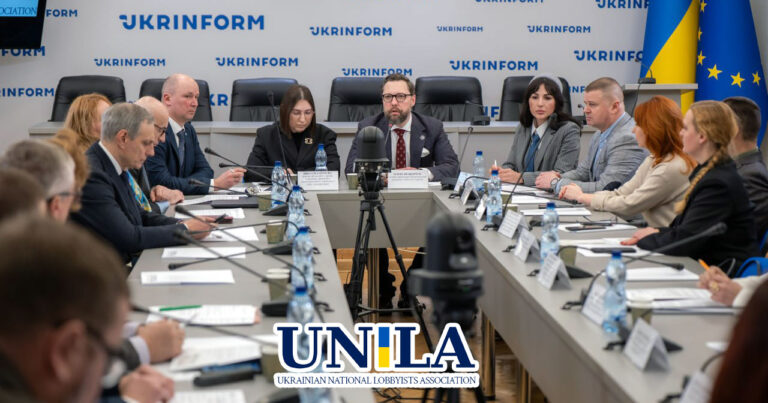
On June 26, 2026, a public discussion was held at the UNIAN press center on the topic: “Why Does the Country Need an Advocacy Registry? What Is the Status of the Law on the Registry of Grant-Receiving Organizations, and Why Should It Be Open? Who is blocking the reform of the advocacy sector in Ukraine?”
Representatives of the professional community, lawyers, and experts on lobbying, advocacy, European integration, and information policy took part in the discussion.
Opening the discussion, the Chairman of the Board of the National Association of Lobbyists of Ukraine, Oleksiy Shevchuk, Chair of the UNLA Lobbying Committee, emphasized the need to move away from informal and non-transparent practices of influencing government bodies toward a clear, open, and accountable system of interest representation.
The discussion centered on three key issues: the introduction of a registry of agents of influence as a tool for transparency and national security; the status of the legislative initiative regarding a registry of grant-making organizations; and the institutional obstacles to reforming the public interest advocacy sector in Ukraine.
During the first part of the event, attorney, Candidate of Legal Sciences and Associate Professor Kyrylo Legkykh drew attention to international experience with foreign influence registries and the need to discuss the possibility of creating a mechanism in Ukraine that would allow society and the state to identify the actual actors influencing the public decision-making process.
At the same time, the speaker emphasized that the introduction of such a registry could carry the risk of curtailing rights, increasing additional state oversight, stigmatizing the relevant organizations and individuals, and the use of the very term “agent of influence” for propaganda purposes.
According to his approach, transparency in this area should be viewed not as a formal bureaucratic requirement, but as a means of safeguarding statehood, the democratic process, and information security. Especially in the context of war, the issue of transparency regarding funding sources, beneficiaries, and channels of influence takes on not only political but also security significance.
The participants paid particular attention to the European context. Andriy Levkovets, an expert on European integration who joined the event online, outlined the general logic behind European approaches to transparency in interest representation, particularly regarding the influence of third countries on democratic processes. The discussion centered on the idea that Ukraine, as it moves along the path of European integration, should not shy away from complex transparency issues but rather develop its own legal mechanisms that take into account European standards, national security, and safeguards for civil society activities.
Viktor Shcherbina, a member of the Ethics Council of the National Association of Lobbyists of Ukraine, Doctor of Sociology, and professor, emphasized in his speech that the issue of advocating for the public interest in Ukraine is much broader than the question of a single registry or a single legislative initiative.
According to him, the discussion today centers on the quality of democracy, society’s ability to be heard, and the rules governing public decision-making. In Ukraine, there is still no uniform legal definition of what exactly constitutes advocacy for public interests, which tools are permissible, who can be considered a legitimate representative of those interests, and what the standards for such activities should be.
Viktor Shcherbina pointed out that the lack of clear boundaries between advocacy, civic engagement, professional representation of interests, and lobbying creates room for manipulation, mistrust, and selective access to decision-making centers. Under such conditions, good-faith participants in the process often find themselves in a less protected position than those who rely on informal connections and opaque mechanisms of influence.
That is precisely why, according to the speaker, establishing transparent rules does not restrict civic engagement. On the contrary, it is a way to protect fair competition, trust in the public sector, professional advocacy, and the very idea of the public interest.
Special emphasis was placed on the role of the Ukrainian National Lobbyists Association as an institution that consistently works to establish professional standards, ethical approaches, and transparent procedures in the field of interest representation. In this context, the UNLA effectively serves as a platform for the transition from informal practices to a civilized, public, and lawful model of interaction between society, business, and the state.
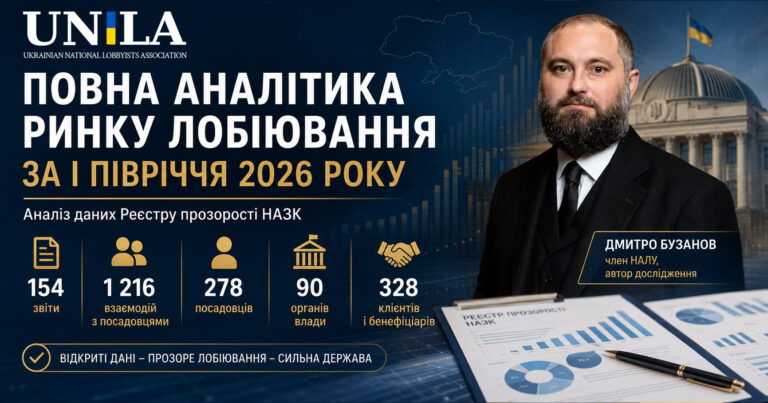
In the third part of the discussion, Dmytro Buzanov —a lawyer, lobbyist, and deputy chair of the NAAU Committee on Information Policy and Media Relations—focused on the issue of the registry of grant-receiving organizations, transparency in funding, and the risks of hidden influence.
He emphasized that uncertainty and the lack of formalization in this area pose real threats. In his view, in the context of war, the transparency of financial channels and sources of influence is not only a matter of administrative transparency but also of national security.
Dmytro Buzanov drew an analogy with the “shadow fleet,” whose effectiveness is based on the lack of transparency regarding its ownership structure, actual beneficiaries, and ultimate purpose. According to him, this same logic can apply to the public sector as well, where an organization or individual experts may formally operate under noble slogans, yet the public cannot see who the actual source of funding is or whose interests are being advanced through these initiatives.
The speaker emphasized that without transparent information about funding sources, the purpose of grant support, and how the funds are used, it is difficult to distinguish a genuine civic initiative from a covert tool of influence. At the same time, a public registry can serve not only as a tool for oversight but also as a safeguard for the reputation of the civil society sector itself, since it is precisely a lack of transparency that creates grounds for manipulative generalizations and the discrediting of reputable organizations.
Participants in the discussion also noted that Ukraine already has practical experience in launching registries to promote transparency in lobbying. Ukraine’s Law “On Lobbying” and the Transparency Registry have become an important step toward the legalization and openness of interest representation. Therefore, further regulation of advocacy activities and transparency in the grant sector should be viewed as a logical continuation of the reform that has already begun.
Following the discussion, participants emphasized the need for a broad professional and public debate on future legislative approaches. Among the proposals put forward during the event was the involvement of representatives from the civil society sector, professional associations, lawyers, experts, and relevant parliamentary committees in developing a legislative framework regarding the openness of advocacy activities and transparency in influencing government authorities.
In summarizing the discussion, the participants reached a consensus: transparency should not be perceived as a threat to civil society. It should become a tool for building trust, protecting organizations of integrity, countering hidden influence, and establishing a level playing field for all participants in the process.
Reforming the public interest advocacy sector is not just a matter of a separate registry or the technical administration of data. It is a question of whether Ukraine will be able to build a system in which rules take precedence over informal connections, arguments carry more weight than backroom influence, and the public interest is genuinely represented in the process of government decision-making.