A Comparative Analysis of Lobbying Legislation in European Union Countries: European Transparency Standards and Prospects for Ukraine
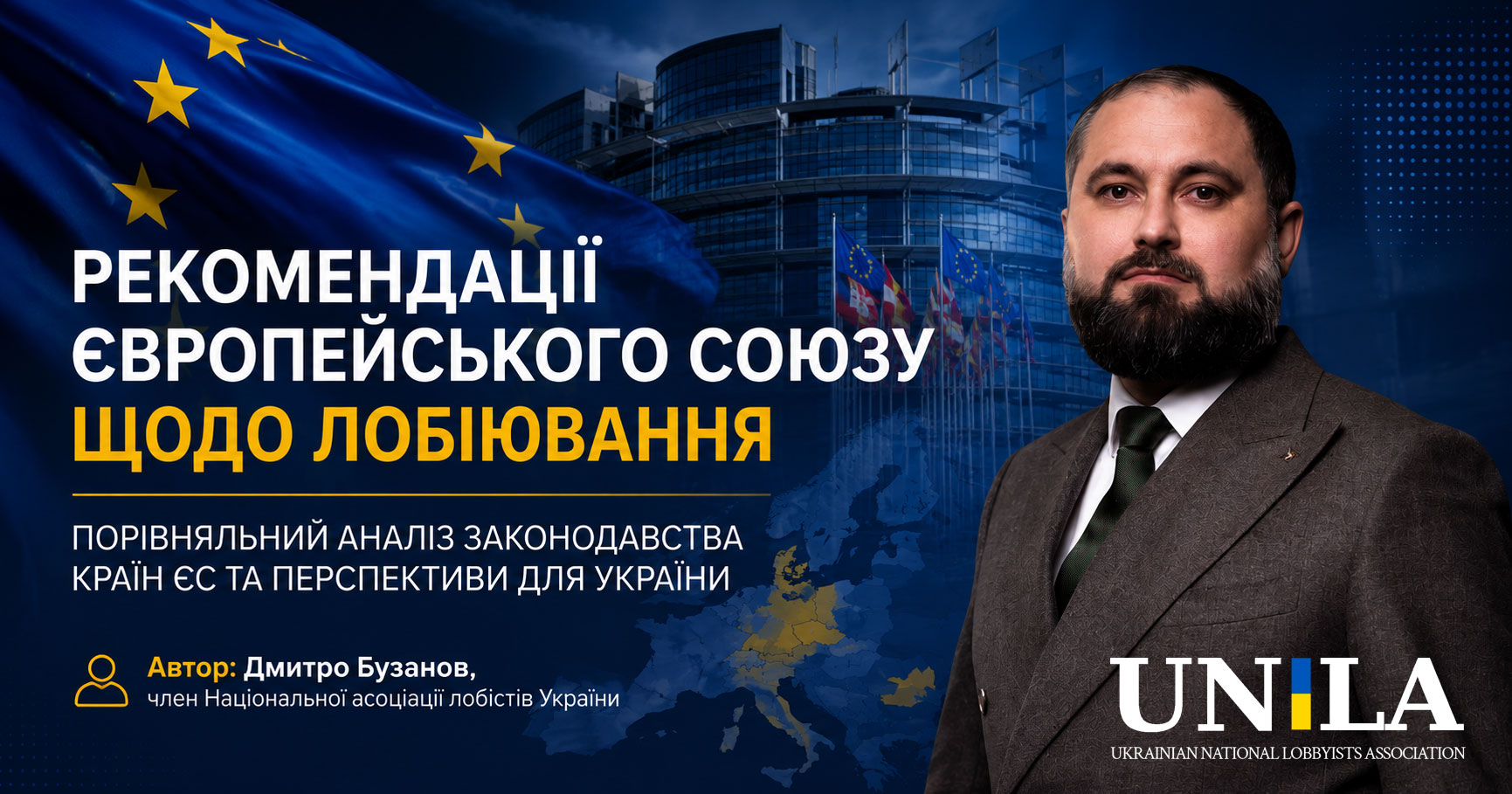
Author: Dmytro Buzanov, member of the Ukrainian National Lobbyists Association
Regulation of lobbying is one of the key elements of the modern system of good governance in European Union member states. Its main goal is not to restrict the representation of interests, but to ensure transparency in the public decision-making process, prevent conflicts of interest, and increase public trust in government authorities.
Despite the absence of a single European Union legislative act, member states have developed various models for the legal regulation of lobbying activities, which are united by common principles: transparency, accountability, ethical standards, and openness in interactions between interest representatives and public officials.
One of the most comprehensive models is the French system. It was established following the adoption of Law No. 2016-1691 of December 9, 2016, “On Transparency, the Fight Against Corruption, and the Modernization of Economic Life” (known as the Loi Sapin II). It was this law that, for the first time, legally defined the status of interest representatives and established a mandatory digital registry of lobbyists, administered by the High Authority for Transparency in Public Life (Haute Autorité pour la transparence de la vie publique – HATVP). As of July 1, 2017, all entities that systematically influence the government decision-making process are required to register, declare their contacts with public officials, the subject of their lobbying, and the resources used to carry out such activities. In addition, French law establishes rules of professional ethics and mechanisms for administrative oversight of lobbyists’ activities. (Legifrance)
Of particular interest is the experience of Ireland, which is considered one of the world leaders in lobbying transparency. The Regulation of Lobbying Act 2015 established one of the most open regulatory models. The law introduced mandatory state registration for individuals engaged in lobbying activities, defined the concept of “lobbying,” the scope of public officials subject to reporting requirements, and mandated the regular submission of electronic declarations for every instance of communication with government authorities. A distinctive feature of the Irish model is the establishment of a so-called “cooling-off period” for certain former high-ranking officials, which minimizes the risks of conflicts of interest after the end of public service. (Irish Statute Book)
For a long time, Germany relied primarily on mechanisms of parliamentary transparency, but in 2021 it implemented a systemic reform by enacting the Lobbyregistergesetz (Lobbyist Registry Act). The law requires the maintenance of a mandatory Lobbyist Registry by the Bundestag and the federal government, which contains information about organizations, their areas of activity, clients, number of staff, and financial resources allocated to representing interests. The reform was an important step toward increasing the transparency of the federal legislative process and ensuring public oversight of the influence of organized interest groups on public policy. (Hatvp)
At the supranational level, the European Union Transparency Register (EU Transparency Register) operates on the basis of an Interinstitutional Agreement between the European Parliament, the Council of the EU, and the European Commission. The Register contains information about organizations and individuals seeking to influence the development of European Union legislation and policy. Registered entities are required to adhere to a single Code of Conduct, and meetings with the European Commission on policy matters are held only with representatives listed in the Register. This mechanism significantly increases the transparency of the European institutions’ activities and ensures public oversight of the decision-making process. (European Commission)
A comparative analysis shows that, despite differences in national regulatory models, European Union countries adhere to a unified concept: lobbying is recognized as a legitimate form of participation in public policy-making, provided it is conducted with the utmost transparency. Mandatory registries, regular disclosure of contacts with public officials, codes of ethics, digital monitoring tools, and effective accountability mechanisms together form the modern European standard for transparent representation of interests.
For Ukraine, which is pursuing a course of European integration and gradually establishing its own system of transparent lobbying, the experience of France, Ireland, Germany, and the institutions of the European Union is of particular practical value. The introduction of an effective system for registering lobbyists, open communication between interest representatives and public officials, and professional ethical standards can become an important factor in strengthening trust in state institutions, developing good governance, and harmonizing Ukrainian legislation with European standards.
A Comparative Analysis of Models for the Legal Regulation of Lobbying in European Union Countries
| Country | Primary Regulatory Act | Lobbyist Registry | Regulatory Authority | Model Features |
| France | Law No. 2016-1691 (Sapin II Law) | Required | Haute Autorité pour la transparence de la vie publique (HATVP) | One of the strictest regulatory regimes in the EU: mandatory registration, annual reporting of activities, a code of conduct, and administrative and criminal liability. |
| Germany | Lobby Register Act (2021) | Required | The Bundestag Administration | A public registry of lobbyists, disclosure of funding, client information, and areas of activity. Mechanisms for tracking the legislative process (legislative footprint) have been implemented. |
| Ireland | Regulation of Lobbying Act of 2015 | Required | Commission on Standards in Public Office (SIPO) | One of the most transparent models in the world. Electronic reporting three times a year, an open online registry, and a “cooling-off period” for former high-ranking officials. |
| Austria | Lobbying and Interest Representation Transparency Act (2012) | Required | Federal Ministry of Justice | It regulates the activities of professional lobbyists, corporate interest representatives, and consulting firms. It establishes a code of conduct and provides for administrative sanctions. |
| Lithuania | Law on Lobbying Activities (new version effective as of 2021) | Required | Main Commission on Professional Ethics (VTEK) | One of the oldest lobbying laws in Central and Eastern Europe. It covers the registration of lobbyists, electronic reporting of contacts with public officials, and the monitoring and prevention of conflicts of interest. |
| Poland | Act on Lobbying Activity in the Lawmaking Process (2005) | Required | Office of the Council of Ministers | The law primarily regulates lobbying in the process of drafting regulatory acts by central government agencies. |
| Slovenia | Integrity and Corruption Prevention Act | Required | Commission for the Prevention of Corruption | Lobbying is integrated into the anti-corruption legal framework. Public officials are required to report their contacts with lobbyists. |
| Belgium | Parliamentary Rules and New Regulations Concerning the Federal Parliament | The registry is operational | Federal Parliament | The main focus is on transparency in parliamentary lobbying, openness in meetings, and the disclosure of representation of interests. The system continues to evolve. |
| The Netherlands | There is no specific law | Partially | Internal Rules of Government Agencies | Regulation is based primarily on the principles of open government, codes of conduct for public officials, transparency of meetings, and access to information. |
| European Union | Interinstitutional Agreement (EU) 2021/611 on a Mandatory Transparency Register | Essential for interacting with key institutions | Joint Secretariat of the Transparency Registry | A single interinstitutional Transparency Register for the European Parliament, the Council of the EU, and the European Commission. It requires compliance with the Code of Conduct and the disclosure of information regarding the activities of interest representatives. |
Key Trends in the Development of European Legislation
A comparative analysis reveals several common trends in the development of lobbying legislation across European Union member states.
- The transition from voluntary to mandatory registration. Most modern models require the maintenance of public registries of lobbyists as a prerequisite for engaging in professional activities.
- Maximum digitization of procedures. Registration, reporting, contact tracing, and public access to information are carried out through electronic platforms.
- Strengthening Ethical Standards. Alongside legislative regulation, codes of professional ethics and rules of ethical conduct are becoming increasingly important.
- Preventing conflicts of interest. European countries actively employ mechanisms such as disclosure of contacts, restrictions on former officials (“cooling-off period”), and oversight of lobbying activities.
- Institutional oversight. The effectiveness of these models is ensured by the activities of independent oversight bodies, which maintain registries, monitor compliance with the law, and impose sanctions.
Comparative Presentation
To clearly illustrate the results of the comparative legal study, lobbyist Dmytro Buzanov prepared a presentation that systematizes the key approaches to the legal regulation of lobbying in European Union member states.
The presentation summarizes the key features of the legislative models of France, Germany, Ireland, Austria, Lithuania, Poland, Slovenia, Belgium, the Netherlands, and the institutions of the European Union. Particular attention is paid to the registration of lobbyists, government oversight bodies, transparency requirements, mechanisms for preventing conflicts of interest, ethical standards, and liability for violations of the law.
The materials in this presentation may be useful to members of the Ukrainian Parliament, representatives of government agencies, the lobbying community, attorneys, scholars, experts, business representatives, and members of civil society who are exploring the development of a modern system of transparent and ethical representation of interests.
We invite you to check out the presentation.
Summary Conclusion
Despite the diversity of national approaches, European practice indicates the emergence of a unified standard for the legal regulation of lobbying. Its key elements include openness in the representation of interests, mandatory registration of professional lobbyists, transparency in interactions with public officials, appropriate institutional oversight, and high standards of professional ethics.
For Ukraine, which is harmonizing its legislation with European Union law, these approaches can serve as a methodological foundation for the further development of the institution of transparent lobbying and the establishment of a modern system of interaction between the state, business, and civil society.