Ukraine–Canada: How a 100-Year Partnership Is Shaping a New Lobbying Market
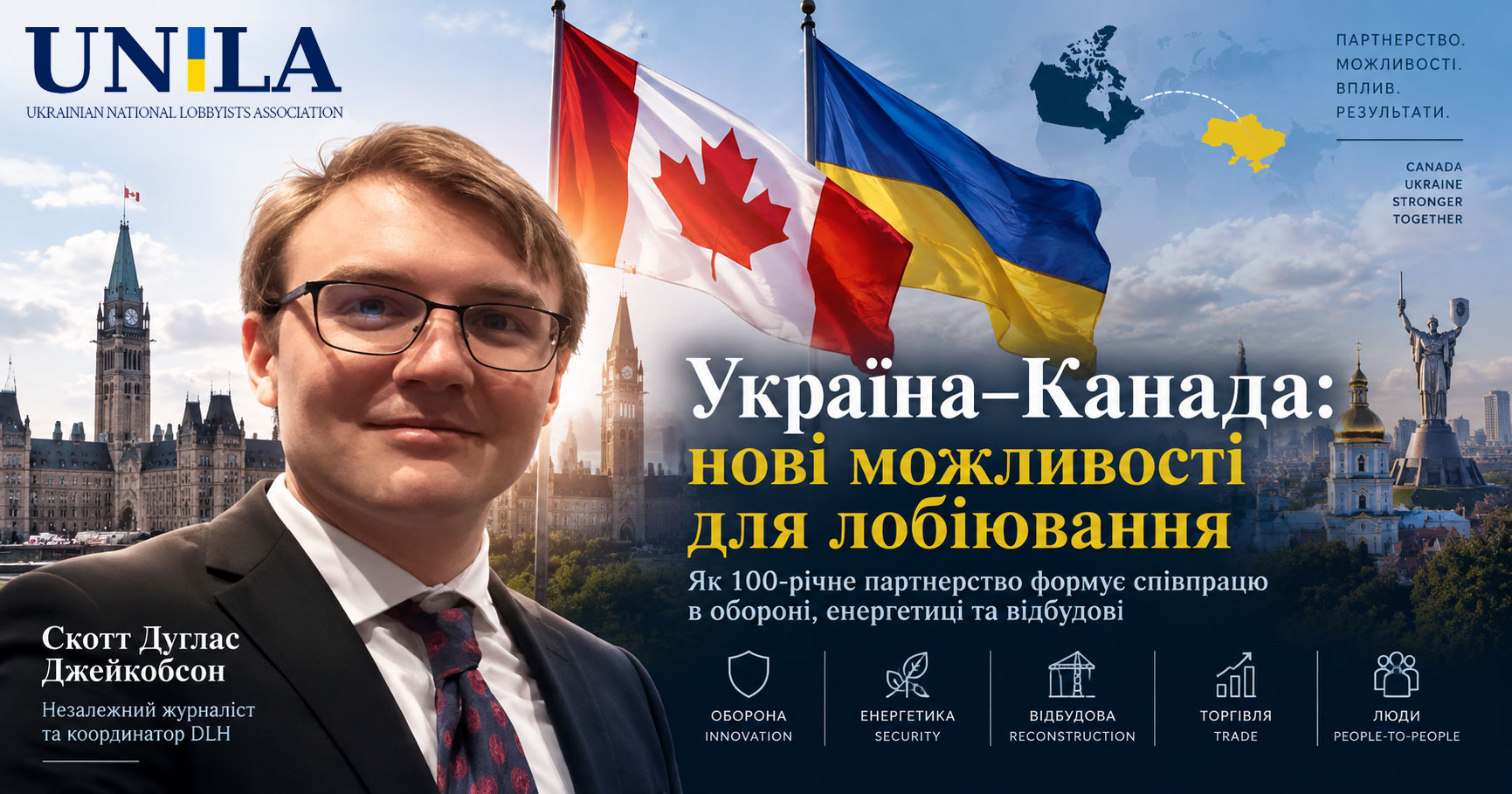
Based on research by Scott Douglas Jacobsen, an independent journalist and coordinator of the Diplomatic Legal Hub
The deepening of relations between Ukraine and Canada, enshrined in the declaration on the 100-year partnership, is not only a political signal but also an indicator of the transformation of international cooperation. This marks a shift from ad hoc support to systematic, long-term cooperation covering defense, energy, reconstruction, trade, and mobility.
It is important to note that the declaration itself is not a legally binding agreement. It serves a different purpose—it establishes a framework for strategic intent. It is within this framework that the demand for lobbying as a tool to influence policymakers, budgets, and regulatory decisions takes shape.
Middle Powers and the Logic of Partnership
As Scott Douglas Jacobson points out, Canada is actively diversifying its international ties in response to economic pressure from the United States and shifts in the global balance of power. Ukraine, for its part, is under direct military pressure from the Russian Federation and is forced to seek sustainable forms of long-term support.
In this context, both countries act as “middle powers” —states that do not single-handedly determine the global order but are capable of significantly influencing it through partnerships.
This model creates a natural environment for the development of lobbying, because:
- Decisions are made through coalitions
- Policies are developed through consultation
- Access to resources is determined by influence
A political declaration as a tool, not an outcome
The declaration signed on September 10, 2026, in Calgary by Canadian Prime Minister Mark Carney and Ukrainian President Volodymyr Zelenskyy is, in essence, a political roadmap.
Jacobson specifically emphasizes an important point: this is not a finalized deal, but a direction of movement. And it is precisely during the stage of shaping such directions that lobbyists wield the greatest influence.
In fact, we’re talking about:
- setting funding priorities
- development of a regulatory framework
- access to government and international programs
Defense and Drone Technology: A Convergence of Interests
One of the key elements of the partnership is defense cooperation, particularly in the field of unmanned technologies.
Ukraine brings the following to this partnership:
- unique combat experience
- practically proven solutions in the field of drones
Canada — a different type of resource:
- funding
- industrial capabilities
- access to global defense markets
In particular, Canada’s Defense Drone Initiative already includes hundreds of suppliers and tens of millions of dollars in contracts. The Ukrainian platform Brave1 serves as one of the sources of inspiration for these efforts.
In this configuration, access to software is determined not only by product quality, but also by the ability to:
- communicate with the government
- influence procurement priorities
- build political support
In other words—classic lobbying tools.
Energy and Reconstruction: Competition for Capital
A separate area of cooperation is energy security and infrastructure reconstruction.
Following a series of attacks on Ukraine’s power grid, the issue of reconstruction has become a strategic priority. This involves not only restoration but also modernization:
- electricity grids
- gas infrastructure
- nuclear energy
- critical minerals sector
Canada has already announced significant amounts of support, including guarantees through international financial institutions and direct funding.
This means that a multi-tiered market is emerging, in which:
- Governments set policy
- International Banks — Financing
- business — sales
And it is lobbyists who serve as the link between these levels.
Mobility and Regulatory Decisions
The partnership also aims to facilitate mobility, including the possible inclusion of Ukraine in Canada’s eTA program, as well as the launch of a 2+2 intergovernmental dialogue format.
These decisions are not technical—they are political. Therefore, whether they are adopted depends on:
- advocacy
- negotiations
- systematic communication with governments
Demographic Factors and Trust
An important component of the partnership is the Ukrainian diaspora in Canada, which accounts for about 3.5% of the population. This creates an additional level of trust and political interest.
For lobbyists, this means having:
- natural allies
- channels of influence
- social capital
Lobbying as the Infrastructure of Partnership
The 100-year partnership between Ukraine and Canada is not about the length of time, but about the breadth of vision.
Its implementation will depend not only on governments, but also on how effectively the system of cooperation between the government, the business community, and international partners is structured.
In this system, lobbying ceases to be a supporting tool and becomes part of the infrastructure:
- access to resources
- policy development
- implementation of strategic projects
And that is precisely why, for Ukraine, the issue of developing professional lobbying has become a matter of national interest.