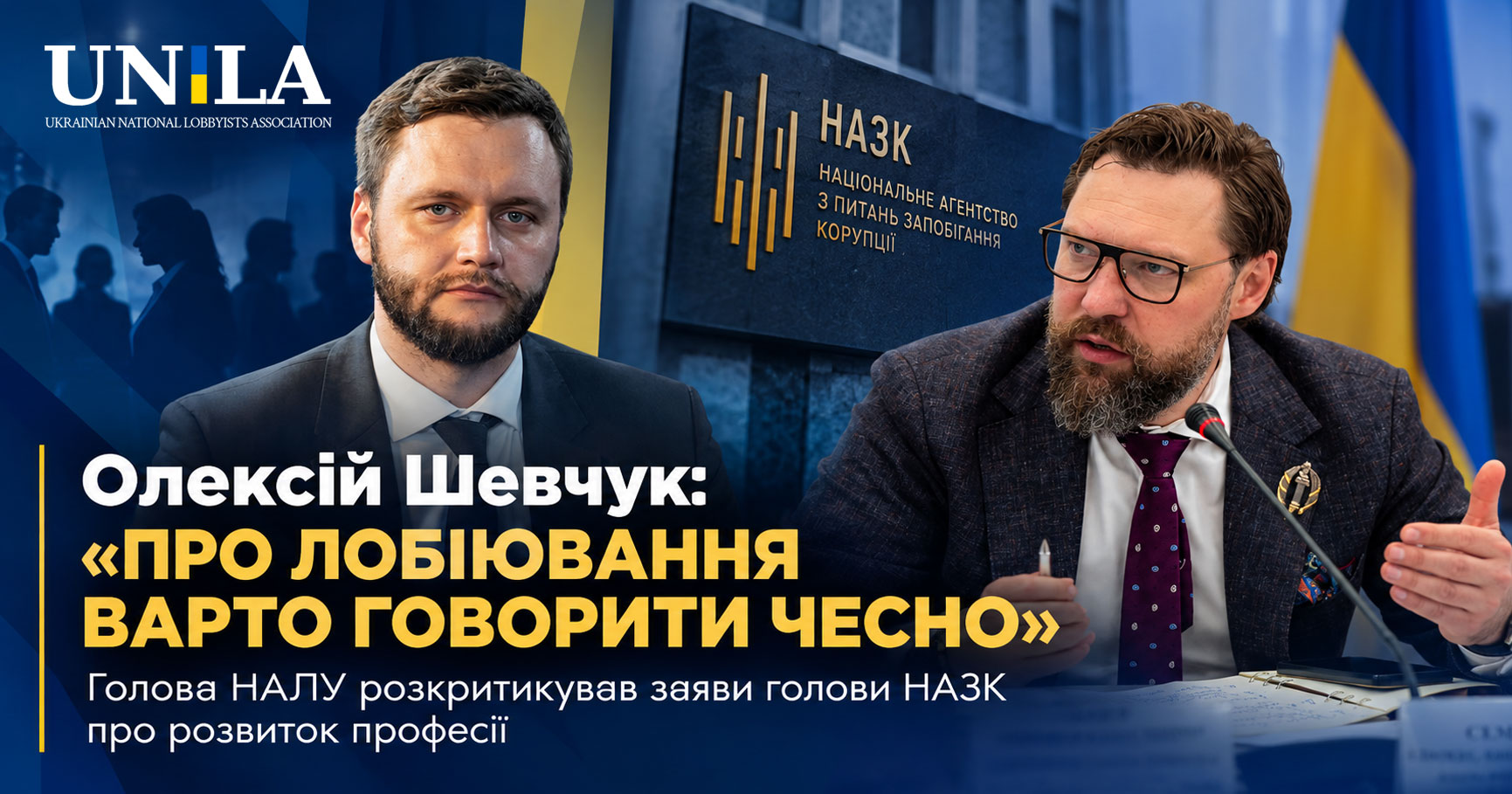
“We Need to Be Honest About Lobbying”: Oleksiy Shevchuk Criticized Viktor Pavlushchyk for the NACP’s Role in the Development of the Profession
Oleksiy Shevchuk, chairman of the Ukrainian National Lobbyists Association, criticized the public stance taken by Viktor Pavlushchik, head of the National Agency on Corruption Prevention, regarding the development of lobbying in Ukraine.
The impetus for this was an interview with Pavlushyk, in which the head of the NACP discussed the first year of implementation of the Law of Ukraine “On Lobbying,” the functioning of the Transparency Registry, the results of lobbyists’ reporting, and upcoming changes to the legislation. According to Shevchuk, through such communications, the NACP is effectively positioning itself as one of the driving forces behind the development of the profession, although, in his view, the Agency’s role is significantly more limited.
“We need to be honest about lobbying,” Shevchuk emphasized.
The head of UNLA noted that, within the first year, a distinct profession with its own professional infrastructure had taken shape in Ukraine. According to him, lobbyists have independently established professional associations, the Higher School of Lobbying, specialized educational and self-regulatory mechanisms, and have also worked on developing professional standards and a separate KVED code.
At the same time, Shevchuk emphasized that, in his view, the NACP had not addressed issues related to the development of the profession—specifically, taxation, professional certifications, or the establishment of self-governance.
“His role under the law is limited: to maintain the Transparency Registry and ensure that reports are submitted on time,” said the head of the Ukrainian National Lobbyists Association.
At the same time, Shevchuk pointed out that a number of areas he considers integral to professional development in lobbying have been implemented by market representatives themselves. Among these, he cited professional guidelines, ethical mechanisms, a supervisory board, and the registration of Ukrainian lobbyists in the European Transparency Register.
Separately, the head of the Ukrainian National Lobbyists Association criticized what he described as the use of the topic of lobbying in the public communications of the NACP leadership.
“It’s unfortunate that the head of the NACP chose lobbying as a topic for a PR stunt, even though he has no connection to the development of the profession,” Shevchuk noted.
According to him, the professional community also faces resistance when it comes to establishing professional standards—specifically at the National Agency for Qualifications and, he claims, at the NACP itself.
Another issue raised by Shevchuk concerned the NACP’s memoranda with certain representatives of the lobbying industry.
“A separate issue is the behind-the-scenes memorandums with individual lobbyists. This appears to be a conflict of interest and ignores the rest of the market: both the National Association of Lobbyists of Ukraine and smaller associations of GR professionals,” said the association’s chairman.
At the same time, in an interview with RBC-Ukraine, Viktor Pavlushchik emphasized another role of the NACP—ensuring transparency in lobbying activities. According to him, during the first year, more than 200 lobbying entities were registered in the Transparency Registry, and more than 1,500 interactions with officials regarding over 500 regulatory acts were recorded. Pavlushchyk also stated that the next step should be the introduction of a “decision trail,” which will make it possible to see which proposals from lobbyists were incorporated into the final regulatory act.
According to the head of the NACP, the Agency’s priorities in the area of lobbying include drafting legislative amendments based on the results of the first year of implementation, conducting public awareness campaigns, and expanding the functionality of the Transparency Registry.
Shevchuk emphasizes that monitoring the transparency of lobbying and advancing the profession are distinct functions and should not be conflated.
“Mr. Pavlushchik, let me remind you: we built this profession on our own. Your involvement in it is merely formal, since you head a body that simply maintains a registry of lobbyists, and your term is limited,” concluded the chairman of the Ukrainian National Lobbyists Association.