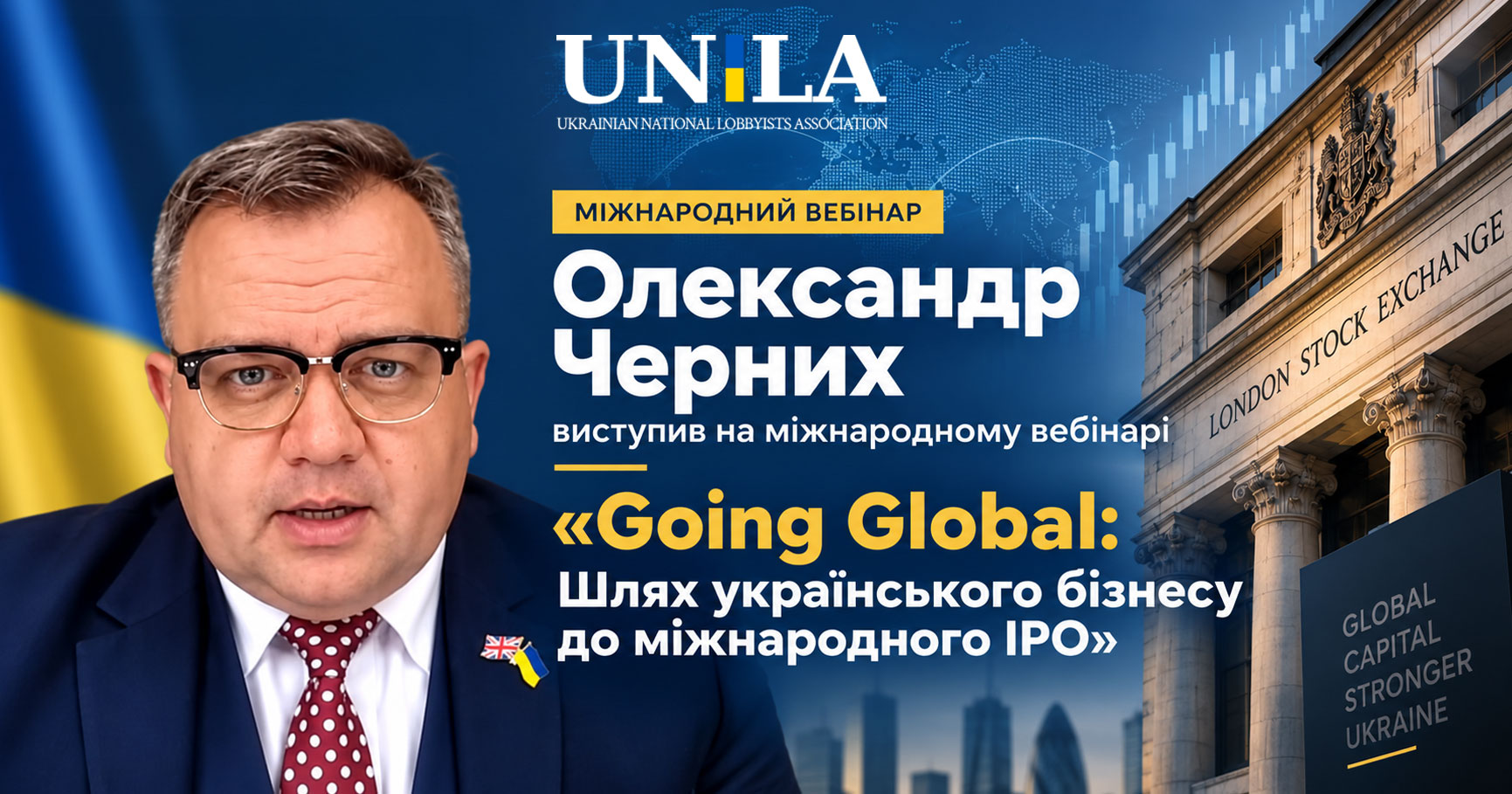
Oleksandr Chernykh spoke at an international webinar on Ukrainian companies going public
Oleksandr Chernykh, a member of the Board of Directors of the Ukrainian National Lobbyists Association, participated in the international webinar “Going Global: The Path for Ukrainian Businesses to an International IPO,” organized by UkraineInvest in collaboration with the London Stock Exchange and HANetf.
The event focused on the practical aspects of preparing Ukrainian companies to enter global stock markets and attract international capital.
The participants discussed the key stages of the IPO process, including the preparatory period, which can last 18–24 months and involves preparing financial statements, establishing corporate governance and internal control systems, setting up a legal structure, and ensuring compliance with the requirements of international investors.
The most intensive phase of an IPO typically lasts 3–5 months and includes regulatory procedures, communication with investors, conducting roadshows, and building the order book.
Special attention was paid to the requirements for Ukrainian companies, including demonstrating financial and operational resilience during the war, transparency in ownership structure, and the potential to participate in Ukraine’s reconstruction.
The webinar also covered new opportunities for Ukrainian issuers, including reforms at the London Stock Exchange, the prospects for companies to be included in FTSE indices, and instruments such as the Ukraine Reconstruction UCITS ETF (UKRN).
Securitization and Tokenization: Key Approaches
In his presentation, Oleksandr Chernykh focused on comparing securitization, tokenization, and traditional capital market instruments.
The key finding was that access to international financing is determined not by the technological form of the instrument, but by the quality of the asset and the legal infrastructure.
Investors and regulators primarily evaluate the following:
— the quality and legal certainty of the asset;
— stable and predictable cash flow;
— protection of investor rights;
— a transparent ownership structure;
— full disclosure of information;
— AML/KYC compliance;
— effective corporate governance;
— clear mechanisms for exiting an investment.
Oleksandr Chernykh emphasized that tokenization should not replace securitization. First, a fully-fledged investment instrument with an appropriate legal structure must be created; only then can technological solutions be applied to improve the efficiency of circulation, accounting, and distribution.
International Markets as the Key to Capital
According to the speaker, the issue of access to international capital is a systemic one for Ukraine, as the domestic securities market remains limited and is primarily focused on government securities.
Under these circumstances, the most realistic way for Ukrainian companies to attract long-term investment is to utilize external regulated markets—IPOs, securitized instruments, international indices, and ETFs.
The key factor here is not the technology (whether traditional or blockchain), but the level of legal protection for investors, the transparency of the structure, and compliance with regulatory requirements.
“Ukraine doesn’t just need new tokens. Ukraine needs assets that are suitable for investment in international markets,” concluded Oleksandr Chernykh.
Representatives from the London Stock Exchange, HANetf, UkraineInvest, KPMG, and independent capital market experts also participated in the webinar.