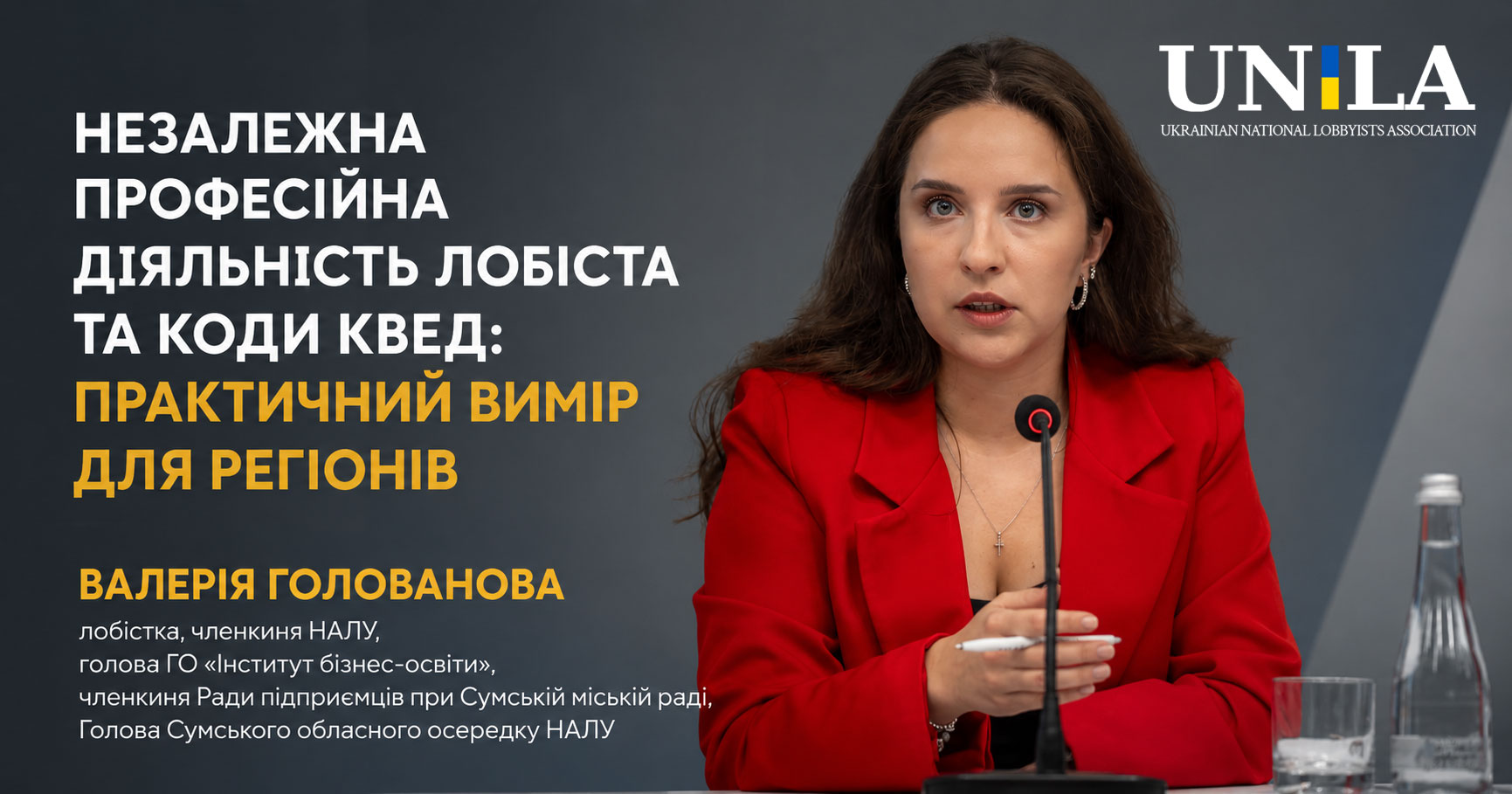
Independent Professional Lobbying Activities and NACE Codes: Practical Implications for Regions
Author: Valeria Golovanova, lobbyist, member of the Ukrainian National Lobbyists Association (UNLA), chair of the Institute of Business Education, member of the Entrepreneurs’ Council at the Sumy City Council, and chair of the Sumy Regional Branch of UNLA
The adoption of the Law of Ukraine “On Lobbying” marked an important step toward establishing a transparent and civilized market for interest representation in Ukraine. At the same time, the new legislation has raised a number of questions for practitioners that require further legal and tax analysis.
For representatives of regional businesses, civil society organizations, and future lobbyists, two issues are particularly relevant today:
- Can a lobbyist engage in such activities as an independent professional without registering as a sole proprietor?
- Which NACE codes should be used for lobbying activities until the relevant changes are made to the national classifications?
Self-employment: Legal Uncertainty Persists
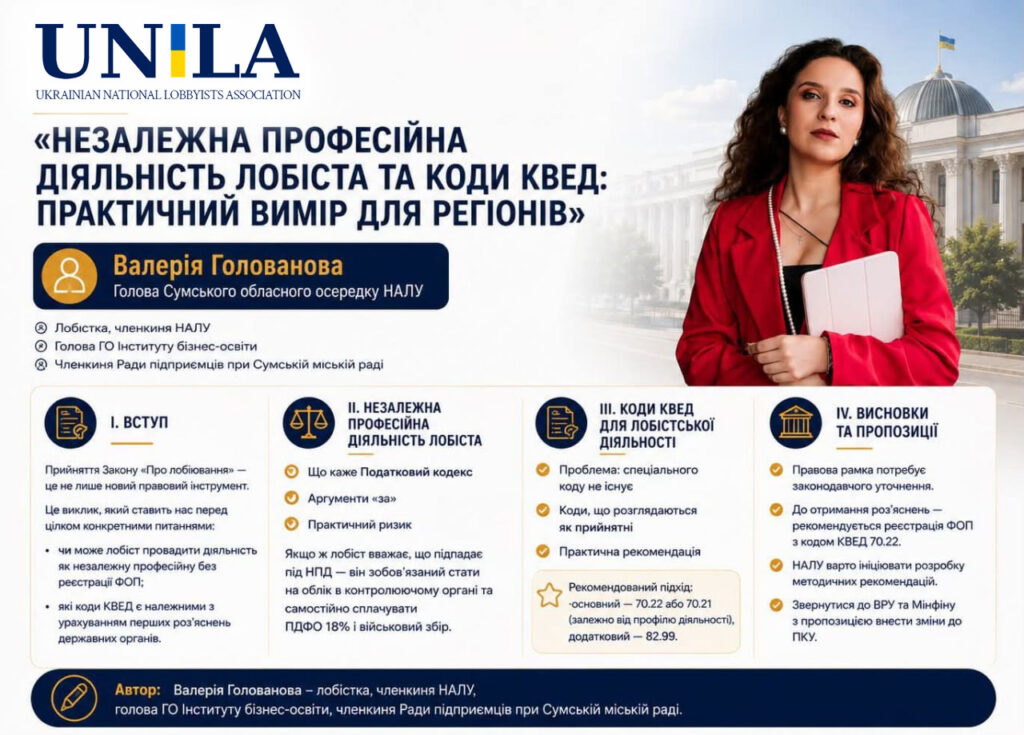
According to subparagraph 14.1.226 of the Tax Code of Ukraine, a self-employed person is an individual entrepreneur or a person engaged in independent professional activities.
Among the types of independent professional activities, the legislature specifically mentions the work of attorneys, notaries, arbitration administrators, auditors, physicians, researchers, and representatives of other professions related to the provision of intellectual services.
At the same time, lobbying is not currently mentioned explicitly in this list.
This is precisely what creates a certain degree of legal uncertainty for individuals who plan to engage in lobbying on a professional basis.
On the one hand, lobbying has all the hallmarks of an intellectual professional activity carried out independently, at one’s own risk, and outside the scope of an employment relationship. By its nature, such activity is similar to legal, consulting, and expert practice.
In addition, the Law of Ukraine “On Lobbying” effectively recognizes lobbying as a distinct professional activity.
On the other hand, the absence of any explicit mention of lobbying in the Tax Code creates a risk that the relevant provisions will be interpreted differently by regulatory authorities.
That is why, in practice, registering as a sole proprietor remains the safest option for engaging in lobbying activities today.
At the same time, UNLA has consistently advocated for the need to address this legislative loophole by amending the Tax Code of Ukraine or issuing official clarifications from the State Tax Service of Ukraine.
Which NACE codes should a lobbyist use?
A separate practical issue is the absence of a specific economic activity code for lobbying in the DK 009:2010 classification.
Currently, lobbyists are forced to engage in related economic activities that best reflect the nature of their work.
Among the codes that can be applied in practice, the following are worth highlighting:
NACE Code 70.22
“Consulting on commercial activities and management”
This code is currently the most widely used by professionals who provide services in the areas of business-government relations, regulatory policy, and strategic consulting.
Given its content, it can be considered the most versatile option for lobbyists.
NACE Code 70.21
“Public relations activities”
This code covers the communications aspect of our activities, including interactions with the media, the public, and government agencies.
It may be particularly relevant for professionals whose work combines lobbying and public relations.
NACE Code 82.99
“Provision of other supporting business services, n.e.c.”
It may be used as an additional code for specific activities related to representing clients’ interests.
NACE Code 69.10
“Legal services”
Ideal for lawyers and attorneys who combine legal practice with managing interactions with government agencies.
At the same time, codes related to the functioning of government agencies—specifically 84.11 and 84.13—may not be used by private lobbying entities.
A practical approach for the regions
An analysis of the practice of registering lobbying entities in the regions shows that the most common approach is to use NACE code 70.22 as the primary business activity.
Based on current practices for registering sole proprietorships in 2025–2026, this is the code most frequently used by individuals working in the fields of government relations, public affairs, and lobbying.
At the same time, it is crucial not only to select the correct NACE code but also to ensure that the actual business activities align with the description of the selected economic activity.
That is why it is important that the wording of contracts, work completion certificates, and other source documents accurately reflect the nature of the services actually provided to clients.
What needs improvement
The first few months of the practical implementation of the Law of Ukraine “On Lobbying” demonstrate the need for further improvements to the regulatory framework.
Among the top priorities of the professional community are:
- the preparation of official guidelines regarding the possibility of engaging in lobbying as an independent professional activity;
- the development of guidelines on selecting the appropriate NACE code for lobbying entities;
- amending the Tax Code of Ukraine to include lobbying in the list of types of independent professional activities;
- the development of a uniform law enforcement practice for all regions of Ukraine.
Conclusion
Lobbying is gradually becoming an integral part of Ukraine’s legal landscape.
As the profession evolves, clear rules should be established regarding the tax status of lobbying entities, the procedures for their registration, and the selection of types of economic activity.
These issues are of particular importance to the regions, as it is at the local level that new mechanisms for cooperation between business, civil society, and the government are actually implemented.
The Ukrainian National Lobbyists Association continues to work on establishing professional standards for the industry and is ready to contribute to the development of proposals for improving lobbying legislation.