
International Experience in Regulating Lobbying: How the Models in the U.S. and European Countries Work, and What Solutions Ukraine Needs
Pavlo Hez
Attorney, Doctor of Philosophy in Law,
Head of the Dnipropetrovsk Regional Branch
of the Ukrainian National Lobbyists Association
Ukraine has begun the practical process of establishing a legal lobbying market. Following the enactment of the Law of Ukraine “On Lobbying,” the discussion has naturally shifted from general issues regarding the legalization of the profession to specific rules governing its practice: the conclusion of contracts, the registration of lobbying entities, reporting, documentary evidence of expenses, and the taxation of funds received.
The issue of taxation, in particular, requires special attention. Any professional activity that involves receiving compensation must be conducted transparently and accompanied by the proper payment of taxes. However, the legalization of lobbying should not result in an additional tax burden simply because the activity is new to the Ukrainian legal framework.
International experience shows that in countries with a well-developed lobbying system, transparency is not replaced by excessive taxation. The law establishes rules for registration, reporting, disclosure of client information, areas of influence, and financial indicators. At the same time, a special “lobbying tax” is not imposed as a punishment for practicing the profession.
This is of fundamental importance for Ukraine. The state’s task is not to create yet another maze of vague tax rules for lobbyists, but to ensure a clear legal framework for activities that already exist in society and the economy and must now become transparent.
1. The right question is not “how much more to collect,” but “how to ensure transparency”
In international practice, it is necessary to distinguish between at least three levels of legal regulation of lobbying.
The first level is the legal status of the activity. The law defines who can be a lobbyist, on whose behalf they act, with which public authorities they interact, and what actions constitute lobbying.
The second level is public transparency. Lobbyists must register, disclose information about their clients or areas of interest, submit reports on their activities, and adhere to the rules of professional ethics.
The third level is taxation. Income from the provision of professional services is taxed in accordance with general rules, which depend on the entity’s organizational and legal form, its tax status, and the nature of the specific transactions.
Mixing these levels creates the risk of a double burden. Registration in a special registry should not automatically imply the application of a separate tax. Public reporting should not become a simplified tool for arbitrarily determining tax liabilities. And funds received to cover documented expenses cannot always be equated with a lobbyist’s net compensation.
In 2024, the Organization for Economic Cooperation and Development updated its Recommendation on Transparency and Integrity in Lobbying. It is based on the premise that advocacy is a legitimate part of the democratic process but requires clear rules that ensure equal access, transparency, and accountability. At the same time, not all OECD countries currently maintain a public lobbyist registry: according to available data, 17 out of the 32 countries assessed have implemented such a mechanism.[1]
Therefore, the development of the institution of lobbying does not lie in creating the strictest system, but in establishing the clearest rules.
2. United States of America: Transparency of Operations and Tax Implications of Expenses
The United States has one of the most detailed models for regulating lobbying. Its key feature is a clear distinction between the registration of lobbying activities and their tax implications.
2.1. Registration and Regular Reporting
The Federal Lobbying Disclosure Act of 1995 requires lobbyists and lobbying firms to disclose information about their activities. Registration must be completed no later than 45 days after the first lobbying contact or after an individual is engaged to carry it out.[2]
Effective January 1, 2025, updated financial thresholds will apply. A lobbying firm is not required to register with respect to a particular client if its revenue from that client does not exceed $3,500 per quarter. For an organization that uses its own employees for in-house lobbying, the applicable spending threshold is US$16,000 per quarter.[2]
After registration, entities must submit quarterly reports no later than 20 days after the end of the reporting quarter. These reports must specify the client, the specific issues on which lobbying took place, draft laws or regulations, the government agencies with which interactions occurred, the lobbyists involved, and financial indicators.[2]
For a lobbying firm, the income from each client, calculated in good faith, is disclosed. For an organization lobbying on its own behalf, the amount of expenses incurred is disclosed.
This is an important distinction. The American model does not equate an outside consultant, who is compensated for their services, with a company that expends its own resources to represent its interests.
2.2. Federal Tax Rule: Limitations on the Right to Deduct Expenses
The focus of U.S. tax law is not on imposing a special tax on professional lobbyists, but on determining the tax consequences for the client.
Under § 162(e) of the Internal Revenue Code, certain expenses related to lobbying and political activities cannot be treated as deductible expenses that reduce taxable income. These include, in particular, expenses incurred to influence legislation, participate in political campaigns, attempt to influence the public regarding elections or legislative issues, and certain communications with executive branch officials.[3]
This rule must be interpreted correctly. It does not create a separate tax on the profession of lobbying, nor does it mean that any payment to a lobbying firm is automatically deemed non-deductible. The specific consequences depend on the nature of the service, its documentation, the nature of the activity, and the exceptions established by law.
A separate mechanism is provided for certain nonprofit organizations, including professional and business associations. If a portion of membership dues is used for lobbying activities, the organization must notify its members of the amount that is not deductible as an expense. In the absence of such notification, a so-called “proxy tax” may be imposed in accordance with § 6033(e) of the Internal Revenue Code.[4]
2.3. What Ukraine Should Consider
The American model illustrates four important principles.
First, a lobbying firm’s revenue, a client’s expenses, and public reporting are distinct legal categories.
Second, the government must be able to identify who is funding lobbying efforts and on what issues they are focused. However, this does not mean that every transfer of funds automatically constitutes net income for the recipient.
Third, the documents must reflect the actual nature of the transaction: remuneration, research expenses, organizational support, the involvement of other specialists, and reimbursement of expenses actually incurred.
Fourth, the tax implications should be predictable before the contract is signed, rather than determined after an audit.
3. The European Union: Transparent Access Without a Separate Tax on the Profession
At the European Union level, a model has been established in which transparency is a de facto prerequisite for stakeholders to participate in the decision-making process.
In 2021, the European Parliament, the Council of the EU, and the European Commission concluded an Interinstitutional Agreement on a mandatory Transparency Register. It is based on the principle of conditionality: in order to have certain opportunities to engage with EU institutions, a lobbyist must be registered.[5]
The register contains information about organizations and individuals seeking to influence the formulation or implementation of EU policy: whom they represent, what interests they promote, what resources they use, and what their sources of funding are. Registered entities undertake to comply with the Code of Conduct and to update their information regularly.[5]
At the same time, the European Union does not impose a special “lobbying tax.” Direct taxation of the income of individuals and companies remains primarily within the jurisdiction of the member states. At the EU level, the rules governing indirect taxation—in particular, value-added tax—have been harmonized.
The general rules of Council Directive 2006/112/EC on the common system of VAT apply to services. In particular, pursuant to Article 44 of the Directive, the place of supply of services to a taxable person in business-to-business transactions is, as a general rule, the place where the customer has established its business.[5]
Therefore, even in cross-border transactions, lobbying services do not require the creation of a separate tax structure. They must be properly classified, documented, and taxed in accordance with the general rules applicable to professional services.
4. National Models of European Countries
European countries use various regulatory mechanisms. However, they are united by a common logic: specific lobbying legislation governs transparency, ethics, and reporting, rather than imposing a separate tax solely based on membership in a profession.
4.1. France: The Legitimacy of Interest Representation and Oversight by the HATVP
The French model has evolved significantly following the adoption of Law No. 2016-1691 of December 9, 2016, known as Sapin II.
As of July 1, 2017, lobbyists who interact with designated officials with the aim of influencing public decisions must register in the digital registry. It is administered by the Haute Autorité pour la transparence de la vie publique —the High Authority for Transparency in Public Life.[6]
French law does not view lobbying as inherently negative. On the contrary, the official approach recognizes the representation of interests as a legitimate part of the democratic process, provided it is conducted openly and responsibly.
Registered entities must file an annual report on their activities and the resources they have used within three months after the end of the fiscal year. Article 18-5 of Law No. 2013-907 of October 11, 2013, establishes ethical principles for the activities of interest representatives.[6]
HATVP has the authority to verify the information submitted, request documents, and conduct inspections. Failure to comply with the obligation to provide information or a repeat violation of ethical rules after an official warning may result in criminal penalties: up to one year of imprisonment and a fine of up to 15,000 euros.[6]
The key takeaway from the French model is that strict oversight is not the same as additional taxation. The government requires transparency but does not create a separate fiscal barrier to entry into the profession.
4.2. Germany: Detailed Financial Disclosure and a Ban on Performance-Based Compensation
In Germany, the Lobbyist Registry Act ( Lobbyregistergesetz ) has been in effect since 2022, and its significantly strengthened version took effect on March 1, 2024.[7]
The law covers the representation of interests before the Bundestag and the Federal Government. The obligation to register arises, in particular, if activities are carried out regularly, on a permanent basis, on a commercial basis for third parties, in exchange for compensation, or if more than 30 separate contacts have been made within a three-month period.[7]
A distinctive feature of the German model is the detailed disclosure of financial indicators. Entities report on their main sources of funding, annual advocacy expenses broken down by specific ranges, grants, public funding, donations, and membership dues. For activities conducted on behalf of a client, information is also disclosed regarding the clients and the financial resources received under the relevant mandate.[7]
Public disclosure is made in the following ranges: expenses for representing clients’ interests—in increments of 10,000 euros—and funds received from a client under a corresponding mandate—in increments of 50,000 euros.[7]
The ban on success fees—remuneration that depends solely on achieving a specific lobbying outcome—deserves special attention. This approach reduces the risk of professional advocacy turning into a trade in guaranteed decisions by public authorities.[7]
The German model illustrates another fundamental distinction: public financial reporting is provided to ensure transparency, but it does not replace accounting and tax reporting. The range specified in the public registry cannot automatically be used as an exact tax base.
4.3. Ireland: A simple system that is actually feasible
Ireland has the Regulation of Lobbying Act 2015. It establishes a clear framework: a person who meets the criteria set forth in the law must not engage in lobbying without registering.[8]
Reports are filed for four-month periods ending on the last day of April, August, and December. After the end of the relevant period, the entity has 21 days to file the report. This requirement may apply to companies, sole proprietors, partnerships, professional associations, public organizations, and individual citizens, depending on the nature of their activities.[8]
It is important to note that registration is free of charge. The government does not impose any financial barriers to compliance with the law.[8]
The Irish approach is particularly useful for Ukraine. Excessively complex regulations often lead not to greater transparency, but to an increase in errors and technical noncompliance. An effective system must not only be rigorous, but also practical enough for everyday use.
4.4. Austria: The Contract for Services as a Standard Legal Framework
The Austrian Lobbying and Interest Representation Transparency Act explicitly defines a lobbying mandate as a paid contract. The law also distinguishes between a lobbying firm, a professional lobbyist, a corporate lobbyist, and an organization that represents the interests of its members.[9]
This approach has significant methodological importance. Fees for lawful professional representation of interests are neither concealed nor disguised as other types of consulting services. They are recognized as a normal component of contractual relationships, provided that transparency rules are followed.
5. What is the actual tax burden in different countries?
The absence of a specific tax on lobbying does not mean that professional activities are exempt from taxation. On the contrary, lobbying firms pay taxes on the same basis as other entities that provide professional, consulting, or analytical services.
To make a fair comparison, it is necessary to distinguish between at least two types of tax payments:
- corporate income tax, which is paid on the company’s financial results;
- value-added tax or a similar indirect tax, which, as a general rule, is included in the cost of the service if there are grounds established by law.
The specific tax burden may depend on the entity’s organizational and legal form, the amount of its revenue, the place where services are provided, the customer’s status, and the specifics of the cross-border transaction. However, the base rates provide a general framework.
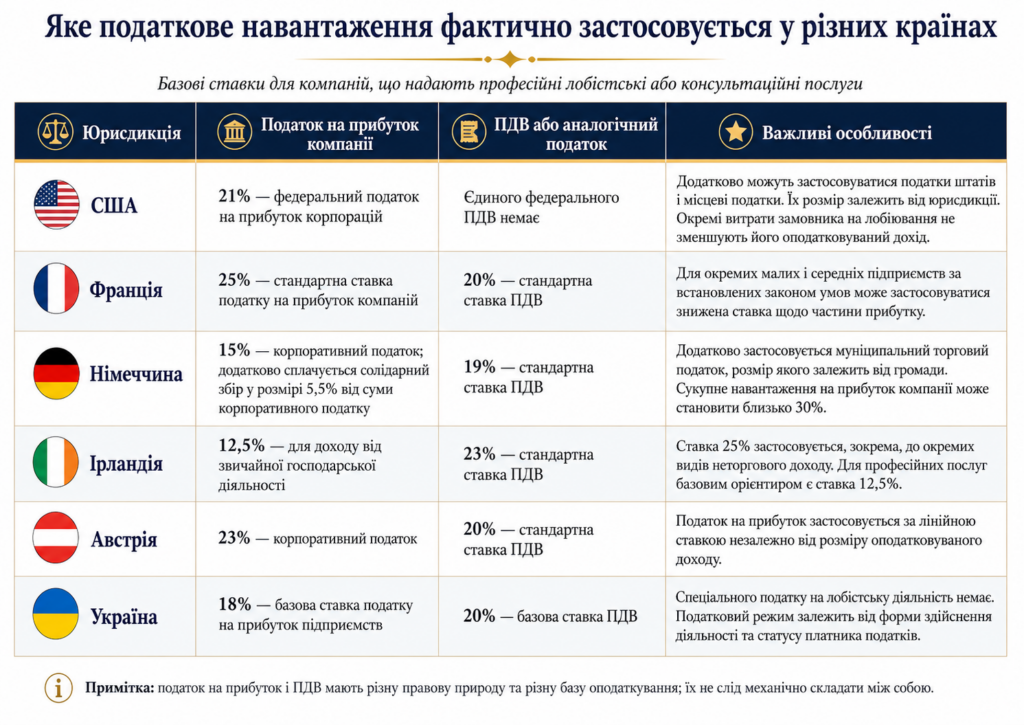
These figures cannot be mechanically added together. Income tax and VAT have different legal natures and different tax bases. VAT, as a rule, is not a tax on the service provider’s net income: it is levied on the provision of services and is accounted for in the relationship between the service provider, the customer, and the government.
United States of America: 21% at the federal level, but without a single, uniform rate for the entire country
In the United States, the federal corporate income tax rate is 21%. However, the U.S. model is not limited to the federal level. Depending on the state and local jurisdiction, additional taxes may apply to income, transactions, or certain types of services.
That is why it is incorrect to claim that any lobbying firm in the U.S. pays only 21%. This is the base federal rate, to which state or local taxes may be added in certain cases.
Section 162(e) of the Internal Revenue Code is particularly significant: certain lobbying-related expenses incurred by a client cannot be deducted from its taxable income. Thus, U.S. lawmakers do not impose a higher tax on lobbyists, but they do limit a client’s ability to derive a tax benefit from certain expenses incurred to influence public decisions.
France: Standard European design
In France, the standard corporate income tax rate is 25%, and the standard VAT rate is 20%.
These rates apply to a lobbying firm not because of its special status as an interest representative, but because it engages in ordinary commercial activities for a fee. Specific legislation on lobbying regulates transparency, reporting, and ethical standards, but does not establish a separate tax regime.
Germany: A Multi-Tiered Tax Burden
In Germany, the base corporate income tax rate is 15%. In addition, a solidarity surcharge of 5.5% of the corporate income tax amount is levied, which effectively corresponds to 0.825% of taxable income.
In addition, the company pays a sales tax, the rate of which is determined at the municipal level. That is why the total tax burden on the company’s profits can be around 30%, and in some cities, it may be higher or lower. The standard VAT rate is 19%.
The German example clearly demonstrates that even with detailed regulation of lobbying activities, the taxation of such activities remains part of the overall corporate tax system.
Ireland: A Competitive Tax Rate for Ordinary Business Activities
Ireland applies a corporate tax rate of 12.5% to income from ordinary business activities. As a general rule, this rate serves as a benchmark for companies that provide professional lobbying or consulting services.
A 25% rate applies to certain types of non-commercial income. The standard VAT rate is 23%.
Austria: flat tax rate
In Austria, the corporate income tax rate is 23% of a company’s taxable income, regardless of the amount. The standard VAT rate is 20%.
The Austrian model is also noteworthy because the law explicitly recognizes a paid contract for lobbying activities as a standard element of professional relationships. Receiving compensation does not need to be disguised as other consulting services.
European Union: Common VAT Rules, but No Single Corporate Income Tax Rate
At the European Union level, there is no uniform corporate income tax rate for lobbying firms. Direct taxation remains primarily within the jurisdiction of the member states.
European law establishes a general framework for VAT: the standard rate in each member state cannot be lower than 15%. However, the actual rate is determined by national legislation. That is why the standard rate is 20% in France and Austria, 19% in Germany, and 23% in Ireland.
Ukraine in the International Context
In Ukraine, the base corporate income tax rate is 18%, and the base VAT rate is 20%.
Thus, the Ukrainian model does not impose an exceptional or increased tax burden on lobbying firms compared to European countries. The main objective is not to set a new tax rate, but to establish clear rules for applying existing taxes to remuneration, actual expenses, services provided by non-residents, and cross-border transactions.
6. The Ukrainian Model: The Necessary Foundation Already Exists
The Law of Ukraine “On Lobbying” established the basic framework for a legal market.
In accordance with Article 5 of the Law, the Transparency Registry, maintained by the National Agency for the Prevention of Corruption, is in operation. The Registry is open to the public and is intended to provide access to information about lobbying entities as required by law.[10]
Article 9 of the Law governs contracts for the provision of lobbying services. Under such a contract, the lobbyist carries out the relevant activities in the commercial interests of the beneficiary, and the client undertakes to pay a fee and/or reimburse all actual expenses necessary for the performance of the contract.[10]
Article 16 establishes a non-cash method of payment for transactions related to lobbying.[10]
Article 17 requires reports to be submitted twice a year: by July 31 and by January 31. The report must include, in particular, information about the contract, its term, the contract price, funds received, expenses for lobbying on one’s own behalf, meetings with officials, and contributions to support political parties. For public disclosure, the following ranges apply: up to 100,000 hryvnias, from 100,000 to 1 million hryvnias, from 1 million to 10 million hryvnias, and over 10 million hryvnias.[10]
The legislature has already established a fundamentally correct distinction: remuneration and reimbursement of actual expenses are different components of contractual payments.
However, a distinction under civil law does not yet eliminate all tax risks. It is necessary to clearly define the conditions under which a documented reimbursement of expenses is not considered to be remuneration for thelobbying entity, which source documents support the relevant transactions, and how they are recorded in the accounting records depending on the individual’s tax status.
This isn’t a matter of special treatment for a lobbyist. It’s a matter of properly classifying the funds.
If a client reimburses the actual costs incurred for conducting research, engaging experts, providing organizational support, or other necessary actions, the government must be able to track all fund flows. However, it should not automatically treat every transit payment as net remuneration for the contractor without taking into account the legal nature of the payment and the specifics of the applicable tax regime.
7. What Needs to Be Done in Ukraine
As the market is taking shape, it is advisable to establish several basic principles.
7.1. Do not impose a separate tax or mandatory fee for the status of lobbyist
Registration in the Transparency Registry should confirm compliance with the law, not create a new fiscal obligation. Ukraine should not turn the legalization of a profession into a paid permit to work transparently.
7.2. Distinguish between compensation and reimbursement of expenses
A standard contract or official guidelines should include a separate definition of:
- the amount of compensation for services;
- a list of expenses that may be reimbursed;
- the procedure for approving additional expenses;
- source documents confirming that they were actually performed;
- rules for engaging other specialists or subcontractors;
- the procedure for reporting payments in financial statements.
At the same time, it is important to avoid the other extreme: the description of the payment in the contract should not be sufficient to change its tax treatment. The classification should depend on the actual substance of the transaction and proper documentary evidence.
7.3. Do not confuse financial statements with tax returns
A public report in the Transparency Registry serves an anti-corruption and informational purpose. Tax reporting serves a fiscal purpose and is based on accurate accounting data.
These documents must be consistent, but not identical.
For example, listing a range such as “from 100,000 to 1 million hryvnias” in a public registry does not allow one to determine the exact amount of income, the tax base, or whether a tax violation has occurred. To do so, contracts, certificates, bank documents, and accounting records are required.
7.4. Provide clear explanations regarding the organizational structure of the work
Market participants need an official algorithm to determine: in which cases activities may be carried out by a legal entity, an individual entrepreneur, a public organization, or another entity provided for by law; how the taxation system is selected; and which economic activity codes should be used.
The current KVED code 70.21, “Public Relations Activities,” explicitly covers, among other things, lobbying activities in support of companies and other organizations. This provides a basis for the practical application of general mechanisms for registering business activities, but does not eliminate the need for an official clarification for this new market.[11]
7.5. Regulate cross-border services
Ukrainian companies may engage foreign consultants, and Ukrainian entities may provide services to non-residents. In such cases, clear rules are needed regarding documentation, foreign exchange transactions, the place of supply of services, and value-added tax.
The experience of the European Union shows that this does not require a separate “lobbying tax.” What is needed is the proper application of general regulations to this new type of legal professional activity.
7.6. Prepare joint recommendations from the NACP and the tax authorities
To ensure legal certainty, it is advisable to develop interagency guidelines that include practical examples:
- conclusion of a contract;
- reporting of compensation;
- reimbursement of actual expenses;
- hiring subcontractors;
- submitting a report to the Transparency Registry;
- record-keeping;
- Taxation of transactions by residents and nonresidents.
Such clarifications should be provided before market participants begin receiving conflicting individual responses and developing practices through trial and error.
8. Conclusion
The legalization of lobbying is not the end, but rather the beginning of a major institutional effort.
The United States demonstrates how to separate a lobbying firm’s public disclosures from the tax implications of its client’s expenditures. The European Union shows how to make transparency a genuine prerequisite for access to the decision-making process. France combines the legitimacy of interest representation with oversight and ethical standards. Germany discloses financial metrics in detail and eliminates success fees. Ireland demonstrates that an effective system can be straightforward and free to register. Austria recognizes a paid lobbying contract as a legitimate legal arrangement.
Ukraine does not need to create a separate tax for a new profession. It needs to ensure that existing taxes are paid properly, distinguish between compensation and verified expenses, standardize practices, and prevent arbitrary interpretations.
Truly effective regulation of lobbying does not begin with additional restrictions, but with clear rules: rules that are transparent, predictable, and equally understandable to the government, the business community, and the professional community.
Legal Framework and Sources for the Article
[1] International standards. The OECD Recommendation on Transparency and Integrity in Lobbying was updated on May 3, 2024. According to the OECD, 17 of the 32 countries for which data is available maintain a public lobbyist registry.
[2] United States: Registration and Reporting. The Lobbying Disclosure Act requires registration within 45 days, quarterly reports, and disclosure of financial information. Effective January 1, 2025, the thresholds are $3,500 in revenue for a lobbying firm and $16,000 in expenses for an organization lobbying on its own behalf.
[3] United States: Taxation of Expenses. Section 162(e) of the Internal Revenue Code imposes restrictions on the deduction of certain expenses related to lobbying and political activities when determining taxable income.
[4] United States: Professional and business associations. Section 6033(e) of the Internal Revenue Code establishes rules for notifying an organization’s members of the portion of their dues allocated to related expenses, as well as a proxy tax mechanism in the absence of proper notification.
[5] European Union. The Interinstitutional Agreement of May 20, 2021, established a Transparency Register model based on the principle of conditionality. The general VAT rules for services are set forth in Council Directive 2006/112/EC, specifically Article 44 for B2B services. Direct taxation remains primarily within the competence of the Member States.
[6] France. The official HATVP overview contains information on the registration of interest representatives, annual reporting, ethical rules, and oversight. Penalties are provided for under the provisions of Law No. 2013-907, as amended.
[7] Germany. Official Bundestag documents and the consolidated text of the Lobbyregistergesetz confirm the rules regarding registration, disclosure of financial information, the prohibition on success fees, and liability for violations.
[8] Ireland. The Regulation of Lobbying Act 2015 establishes requirements for registration and reporting. The official website also confirms four-month reporting periods, a 21-day deadline for submitting reports, and no registration fee.
[9] Austria. Section 4 of the Lobbying and Interest Representation Transparency Act contains definitions of lobbying activities, paid lobbying assignments, lobbying firms, and other parties to the relevant legal relationships.
[10] Ukraine. The Law of Ukraine “On Lobbying” No. 3606-IX entered into force on September 1, 2025. Articles 5, 9, 16, and 17 regulate the Transparency Registry, contracts for lobbying services, non-cash payments, and reporting.
[11] KVED. The official classification system categorizes lobbying activities in support of companies and other organizations under class 70.21, “Public Relations Activities.” The current version of the Tax Code of Ukraine is available on the Verkhovna Rada of Ukraine’s website.